
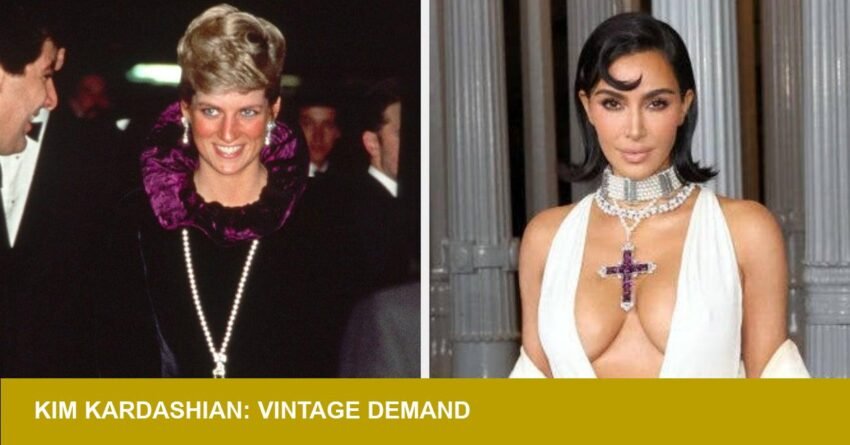
Celebrities are reviving archival couture and, in turn, refocusing buyers on estate and vintage jewelry. Kim Kardashian — who is quoted as owning “arguably the most important dress of the 21st century!” — sits at the center of that renewed attention, an aesthetic cue that is translating into stronger demand for authenticated, museum‑grade accessories and conservatively marketed pre‑owned pieces in the U.S.
- Celebrity: Kim Kardashian — owner of what has been called “arguably the most important dress of the 21st century!”
- Trend: Revival of archival looks among high‑profile celebrities
- Market focus: U.S. estate and vintage‑jewelry channels; retail merchandising opportunity
- Merchandising cue: preference for pieces with provenance, visible craftsmanship, and tactile qualities (vitreous luster, satin‑finished gold)
Context: archival revival within 2025–26 luxury trends
In a market narrowing toward quiet luxury, archival couture functions as a reliable visual shorthand: archival garments lend context to jewelry that emphasizes provenance and craft over flash. For retailers and wholesalers, this recent celebrity activity reframes inventory priorities — vintage necklaces, brooches, and estate rings with documented history are increasingly relevant to customers seeking objects with visible craft language, such as open‑backed settings that showcase color, micro‑pavé that reads like texture at arm’s length, or the silky nacre of period pearl work.
This is not a push toward ostentation but toward considered objects: pieces that show knife‑edge shanks, substantial heft in metalwork, and conserved vitreous luster. The archival‑look revival dovetails with sustainability and traceability themes; pre‑owned and estate inventory offer retailers a lower‑carbon, higher‑story product line that can be certified with provenance rather than recycled material claims alone.
Impact: what U.S. retailers and investors should do
For U.S. merchants, the immediate implication is tactical. Buyers should increase allocation to authenticated estate lots and prioritize condition‑grade over novelty. Merchandising copy must shift from hyperbole to craft detail: describe satinated finishes, the presence of open backs that enhance color saturation, and any conservation work performed. Visual merchandising should pair archival garments or archival‑inspired styling with jewelry that communicates tactile quality — a satin‑finished gold band, a brooch with intact polish and original pinwork — to meet customer expectations set by celebrity placements.
Wholesalers and estate specialists can capitalize on this window by tightening provenance documentation and by offering trade warranties that translate provenance into retail confidence. Investors and category managers should watch assortment turnover: archival‑led demand often favors a slower‑selling, higher‑margin mix rather than high‑velocity, trend‑driven SKUs. For marketing teams, the signal is clear — present vintage alternatives as an investment in craft and story, not merely as a lower‑price substitute.
Because the source of the uptick is celebrity‑led, the effect may be concentrated around editorial cycles. Maintain a measured buying cadence: increase access to estate inventory while retaining liquidity for rapid response if further celebrity visibility amplifies interest.
Image Referance: https://www.buzzfeed.com/kristenharris1/famous-archival-looks-celebs-brought-back