
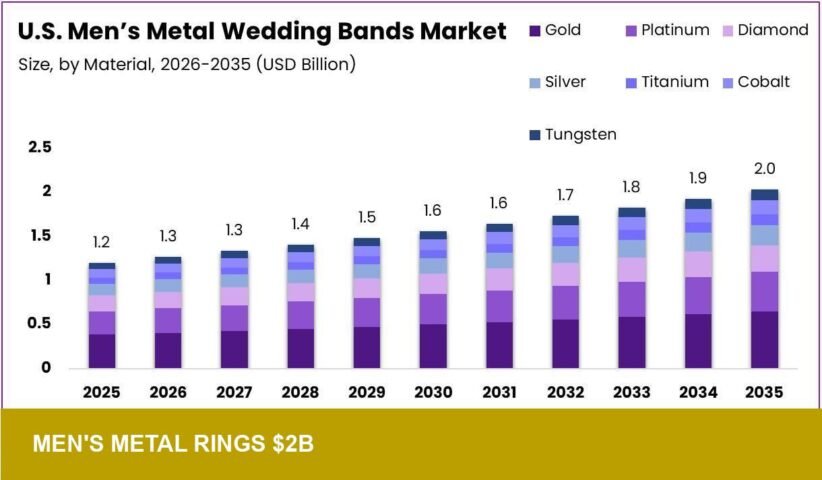
The U.S. men’s metal wedding bands market is forecast to grow from USD 1.2 billion in 2025 to USD 2.0 billion by 2035, at a compound annual growth rate of 5.4%. That projected expansion—across a decade-long horizon—creates a defined opportunity and planning horizon for retailers, wholesalers and investors to reassess assortment, price architecture and material sourcing.
- Market size (2025): USD 1.2 billion
- Projected market (2035): USD 2.0 billion
- CAGR (2025–2035): 5.4%
- Region: United States — men’s metal wedding bands segment
- Planning window: 2025–2035 (retail and wholesale strategy period)
Context: how this sits in 2025–26 jewelry trends
Mid‑2020s product direction for men’s wedding rings has tilted toward restrained, craft‑forward pieces rather than ornamented fashion rings. In physical terms this shows up as narrower profiles with substantial heft, satin‑finished gold and brushed titanium surfaces, clean knife‑edge shanks and fewer high‑set stones. Sustainability and traceability remain active considerations: recycled metals and documented sourcing increasingly inform premium positioning.
For the market forecast above, the relevant vectors in 2025–26 are demand consolidation around a few proven metal types (gold, platinum, tungsten, titanium) and the continued migration of price discovery to digital channels. That combination tends to lengthen product lifecycles and rewards SKU rationalization over broad seasonal churn.
Impact: what U.S. retailers, wholesalers and investors should do
With a 5.4% CAGR implied across 2025–2035, the near‑term implication is operational rather than speculative: inventory mix and margin architecture need alignment to a steady growth trajectory rather than a short, sharp spike. Retailers should prioritize:
- Assortment clarity — concentrate on a measured range of widths, finishes (satin, brushed) and price bands to reduce carrying costs and simplify in‑store advisories.
- Material narratives — document recycled metal content and grade (e.g., 14k vs 18k gold, titanium alloy) on product pages and receipts to support quiet‑luxury messaging without theatrics.
- Channel pricing discipline — expect digital storefronts to continue shaping price discovery; maintain consistent online/offline price architecture to protect margins.
- Service and fit — emphasize bespoke sizing, comfort fit profiles and repair policies; these after‑sale services reinforce higher average selling prices without relying on promotional discounting.
For wholesalers and manufacturers, the forecasted expansion argues for measured capacity investment: scale production for core SKUs while preserving flexibility to develop limited higher‑margin finishes. For investors, the projected steady growth reduces tail‑risk from volatility but shifts focus to margin capture, supply‑chain traceability and digital customer acquisition efficiency.
In short, the USD 2.0 billion target by 2035 positions the men’s metal wedding bands category as a stable growth segment. Success for U.S. operators will come from technical product clarity (heft, finish, profile), disciplined SKU planning, and transparent material sourcing rather than headline promotions.
Image Referance: https://market.us/report/us-mens-metal-wedding-bands-market/