
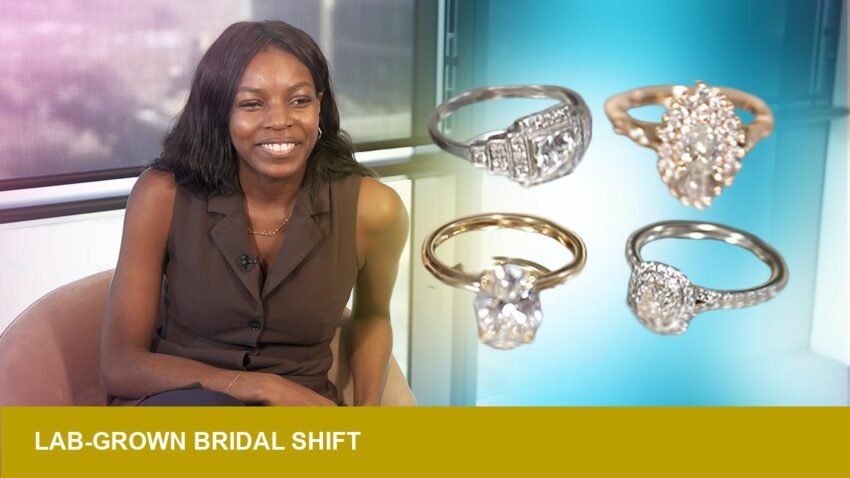
A 2024 industry report found lab-grown diamonds accounted for nearly half of diamond engagement-ring sales in the U.S., a market share that immediately changes assortment and pricing conversations for bridal specialists and national retailers.
- Share: nearly half of U.S. diamond engagement-ring sales (2024)
- Product: lab-grown diamonds (engagement/bridal segment)
- Market: United States
- Source: industry report (2024)
Context: lab-grown adoption and the quiet-luxury shift
Over the past buying cycle lab-grown stones have moved from niche to mainstream within bridal. Retailers describe the category by its consistent optical properties and accessible price points; merchandising increasingly treats lab-grown and natural diamonds as parallel SKUs rather than a single alternative. That reclassification aligns with quiet-luxury directions in bridal design — restrained profiles, knife-edge shanks, open-backed settings to showcase vitreous luster, and micro-pavé accents on satin-finished gold bands — where perceived value rests on finish and fit as much as stone origin.
Impact: what U.S. retailers, wholesalers and investors should consider
For U.S. retailers the near-50% share in engagement sales is a practical signal to rebalance assortment and clarify price architecture. Actions to consider include:
- Inventory mix: maintain a dual assortment strategy with clear tiering so sales staff can present lab-grown and natural options by budget and upgrade path.
- Pricing presentation: display absolute price and per-carat context; separate shelf tags and online filters reduce friction and protect margin on natural stones.
- Merchandising & craftsmanship cues: foreground setting quality — open-backed bezels, polished knife-edge shanks, and precise micro-pavé — to justify price differentiation irrespective of origin.
- After-sale policy and certification: warranties, upgrade credits and transparent reporting on origin build buyer confidence and reduce returns across both categories.
- Marketing tone: adopt quiet-luxury language that emphasizes material quality, finish and fit rather than hyperbolic origin claims.
The report’s finding — lab-grown stones composing nearly half of U.S. engagement purchases in 2024 — is less a headline than a planning metric. Merchants and buyers should treat it as an operational threshold that affects stock turns, vendor terms and online merchandising, not merely a product-story choice.
Image Referance: https://www.wxii12.com/article/lab-grown-vs-natural-diamonds-engagement-rings/70235462