
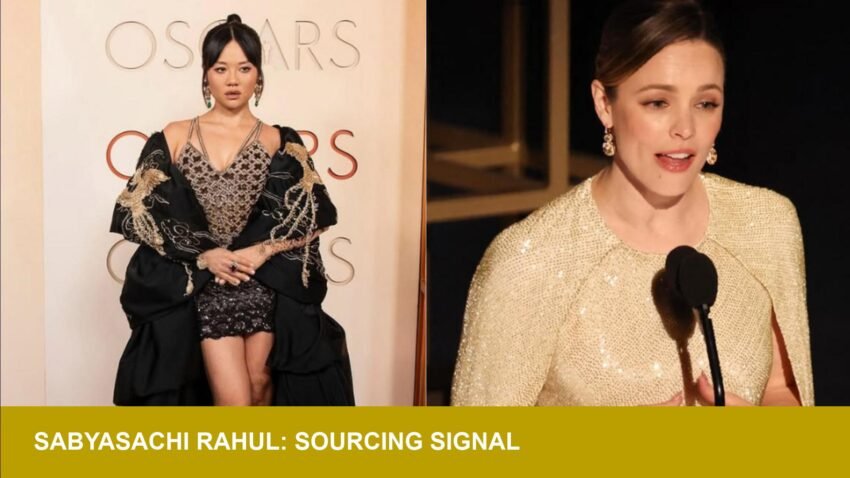
Sabyasachi and Rahul Mishra dressed global celebrities on the Oscars 2026 red carpet, delivering high‑visibility couture moments that extend beyond fashion to jewellery sourcing and merchandising for the US market. The designers’ presence at the world’s most watched awards night increases attention on Indian artisanal technique and couture‑scale pairings—an important consideration for retailers and wholesalers planning assortments for high jewellery and bridal clients.
- Designers: Sabyasachi, Rahul Mishra
- Event: Oscars 2026 (red carpet exposure)
- Audience: global celebrities, international media
- Market note: relevance to US high jewellery, bridal, and luxury retail
Context: craftsmanship, quiet luxury and red‑carpet pairing
Indian couture’s appearance at a global film awards night reaffirms a wider 2025–26 movement toward restrained, artisanally driven luxury. For jewellery professionals the practical takeaway is stylistic: couturiers often favour clean necklines, layered textiles and finely detailed surface work—conditions that naturally pair with collar‑length pieces, delicate micro‑pavé, and designs that read as handcrafted rather than ostentatious. This is not about trend noise but about visibility: couture silhouettes dictate the scale, finish and mounting choices that will photograph best under broadcast lighting.
From a craft standpoint, attention to handwork—embroidery, metal finishing and surface texture—aligns with consumer interest in provenance and traceable supply chains. US buyers who emphasise artisanal narratives and clear origin stories are likely to find better storytelling opportunities when aligning collections with couture that foregrounds technique over logo.
Impact: what US retailers and wholesalers should consider
Visibility for Sabyasachi and Rahul Mishra at the Oscars creates a tactical window for US jewellers to reassess assortment and supplier relationships without assuming immediate volume shifts. Practical responses include staging capsule edits that respect couture proportions (shorter necklaces, fine‑link chains, low‑profile settings), commissioning limited runs with Indian ateliers, or programming trunk shows that pair jewellery and bespoke dressmakers to demonstrate fit and finish.
Merchandising notes for buyers: prioritise pieces with substantial heft in construction but refined visual weight—solid clasps, satin‑finished gold surfaces, and open‑backed settings that maintain a clean silhouette on camera. Marketing should lean into quiet‑luxury cues: nuanced provenance, artisanal technique, and photographic proof of how pieces sit with tailored couture rather than overstated claims.
For investors and category managers, the Oscars moment is a reminder that cultural visibility can shift attention across categories—bridal, red‑carpet, and high jewellery—without immediate pricing signals. The correct response is selective: curate pieces that complement couture scale and storytelling, build relationships with trusted Indian workshops, and document craftsmanship with technical descriptors (metal purity, finish, setting type) so product claims stand up to trade and consumer scrutiny.
In sum, the designers’ red‑carpet placements increase the salience of Indian couture techniques for US jewellery players. That salience is actionable: better curated assortments, deeper supplier partnerships, and marketing that privileges technique and fit over showy branding.
Image Referance: https://www.newsbytesapp.com/news/entertainment/indian-designers-shine-at-oscars-2026/story