
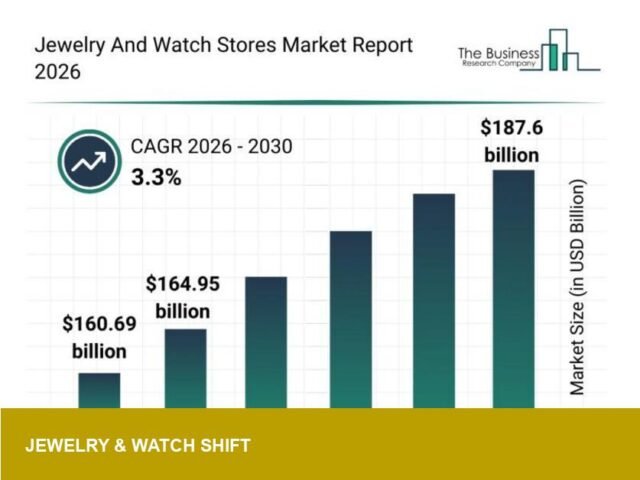
The Business Research Company has published a market report, released on openPR.com, identifying a set of emerging sub‑segments that are transforming the jewelry and watch stores market. The report highlights structural shifts that are already altering retailers’ revenue mix and margin profile as newer product formats and channels gain share.
- Publisher: The Business Research Company
- Distribution: openPR.com (press release)
- Topic: Emerging sub‑segments within jewelry and watch stores
- Audience: Retailers, wholesalers, investors, brand managers
Context: Where this fits in 2025–26 trends
The report arrives amid a broader market recalibration: customer preference fragmentation, greater emphasis on traceability, and channel diversification. Sub‑segments called out in industry analysis — such as lab‑grown diamond bridal assortments, certified pre‑owned mechanical watches, direct‑to‑consumer fine jewellery, and sustainable metal collections — are shifting how product is sourced, priced and merchandised. These formats bring distinct product attributes: micro‑pavé and open‑backed settings that reduce labour cost per carat for entry‑level bridal SKUs; vintage mechanical watches prized for substantial heft and documented service histories; and satin‑finished recycled gold in contemporary collections prioritising provenance over ornamentation.
These shifts are not merely aesthetic. They redefine unit economics. DTC and pre‑owned sub‑segments compress reliance on traditional wholesale markups but offer higher turnover or lower acquisition costs. Sustainable metal lines and lab‑grown diamonds change supplier margins and create new certification and aftercare requirements.
Impact: Why this matters in the US market
For US retailers and wholesalers the report signals practical actions. Merchants should reassess inventory mix to balance legacy high‑margin staples with faster‑turn or lower‑margin sub‑segments that attract younger buyers. Wholesale partners will need clearer product specs—cut, color, clarity, carat ranges and origin disclosure—so retailers can compare margin and lifetime value across categories.
Operationally, merchants may adjust assortment and merchandising: allocate floor space to certified pre‑owned watches with visible service histories, offer lab‑grown diamond bridal sets with knife‑edge shanks and simplified stone‑grading disclosure, or introduce traceable recycled‑metal lines with clear provenance messaging. Marketing should adopt quieter, evidence‑based storytelling—focus on fabrication details (silky nacre for cultured pearls, durable patina on vintage cases, precision cut proportions) rather than hyperbole—so buyers understand tradeoffs between price, durability and resale value.
Investors and category managers should read the report as an inventory and margin signal rather than a short‑term fad call: emerging sub‑segments will reallocate revenue across channels and product types, alter promotional levers, and require different after‑sales and certification investments. The practical takeaway is to map SKU profitability by sub‑segment and to test assortment shifts in controlled market windows rather than full portfolio swaps.
Image Referance: https://www.openpr.com/news/4437150/emerging-sub-segments-transforming-the-jewelry-and-watch