
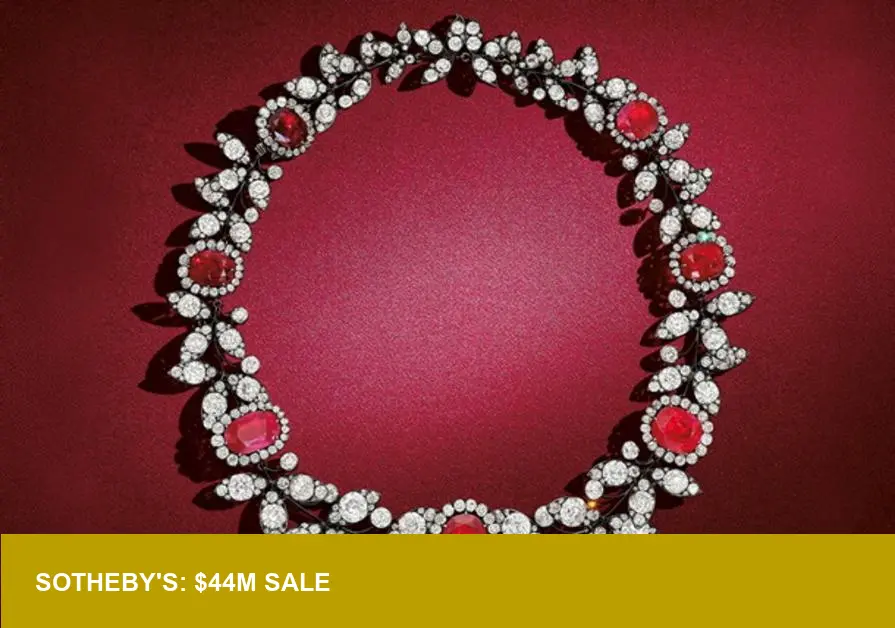
Sotheby’s opened its new Breuer headquarters in New York with an evening jewelry auction that realized $43.9 million, including a private 56-lot collection that outperformed estimates — a clear price-discovery event for blue-chip vintage jewels.
- Price: $43.9 million (total sale); private collection $13.9m vs pre-sale $8m
- Carat Weight: Boucheron laurel necklace ~40 ct rubies + ~65 ct old-cut diamonds
- Origin: “A Legacy of Elegance” — 56-lot private collection; assorted designer lots by Belperron and JAR
- Date: 8 December 2025
- Sell-through: 100% (56-lot collection sold in full)

What happened
Sotheby’s staged its first evening jewelry sale in a decade at the Breuer Building, achieving $43.9m across multiple sessions. The headline figure was anchored by a 56-lot private grouping, “A Legacy of Elegance,” which returned $13.9m—well above the $8m pre-sale estimate—and a white-glove sell-through. Standouts included 24 lots by Suzanne Belperron ($3.5m) and 12 lots by JAR ($5.7m). The top single lot was a late-19th-century Boucheron laurel-wreath necklace, set with seven cushion-shaped rubies totaling ~40 carats and about 65 carats of old mine and old European-cut diamonds; it sold for $1.3m.
Context — 2025 market signals
The result reads as a measured affirmation of 2025 trends. Demand for natural, well-provenanced colored gemstones and signature-designer pieces remains robust even as lab-grown gemstones mature in the retail channel. Buyers paid premiums for sculptural authorship and period presence: JAR’s and Belperron’s pieces carry a particular surface language and vitreous luster that under collectors’ lights translates into price momentum. Sotheby’s move into the Breuer—a structure with institutional gravitas—also sharpened perception of provenance and exhibition-grade pedigree, factors that materially influence hammer prices.
Why the sale matters to US retailers and investors
For U.S. retailers this event is a reminder that the secondary market is currently a reliable source of inventory that can re-price faster than primary retail. The wholesale-to-retail spread on blue-chip vintage makers has compressed in recent months; retailers who can authenticate and present such pieces with disciplined margins will find sustained buyer interest. For investors, the auction underscores several practical points:
- Price discovery: 100% sell-through for a private collection signals active capital chasing limited supply—an indicator for tightening availability and upward pressure on replacement costs.
- Provenance premium: Material provenance (notable prior ownership, museum-quality display) is translating into quantifiable premiums at auction.
- Selective liquidity: High-quality colored stones and maker-attributed designs remain more liquid than undifferentiated goods, a consideration for portfolio allocation.
Practical takeaways
Buyers and stockists should prioritize tactile verification and documentation: condition notes that reference substantial heft, facet symmetry and the vitreous luster of stones are no longer specialist verbosity but pricing determinants. Insurers and appraisers will need to account for the Breuer effect—presentation and institutional context now affect realized value. Finally, cataloguing blue-chip names (Boucheron, JAR, Belperron) with clear attribution accelerates sale velocity and preserves margin.
Quiet but decisive, Sotheby’s $43.9m evening confirms that the upper-tier market for historic gems and signature designers remains a live market for both aesthetic and financial capital into 2026.
Image Referance: https://www.idexonline.com/FullArticle?Id=50963