
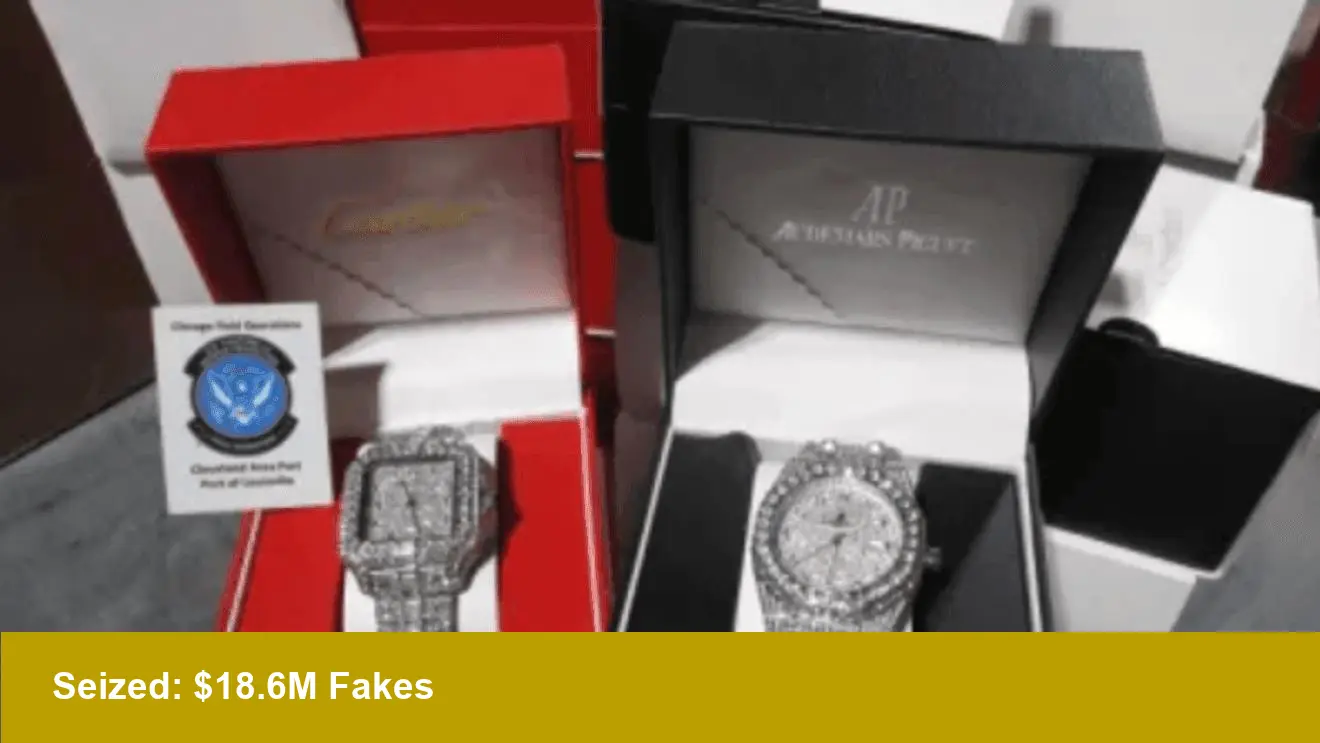
U.S. Customs and Border Protection officers in Louisville intercepted three international shipments containing counterfeit luxury watches and accessories that carried a combined street value of $18.6 million if authentic. The seizure — confirmed by the agency’s Centers of Excellence and Expertise — stopped hundreds of imitation Cartier, Audemars Piguet and Rolex timepieces bound for U.S. addresses.
- Price: $18.6 million (estimated street value)
- Carat weight: Not applicable — watches and branded apparel
- Origin: Hong Kong (two parcels), Taiwan (one parcel)
- Date: Dec. 5–8, 2025
What was seized
On Dec. 5 two parcels from Hong Kong were opened at Louisville’s inbound processing center. One contained roughly 400 imitation Cartier wristwatches alongside Moncler and Chrome Hearts caps; the other held eight counterfeit Cartier pieces and 13 fake Audemars Piguet models. Three days later a third shipment from Taiwan was found to contain 160 counterfeit Rolex watches — split into 80 Cosmographs and 80 Day‑Dates — en route to Houston. Each item bore protected trademarks and visible cues of luxury: polished bezels with vitreous luster, stamped trademarks on crowns, and a substantial heft engineered to mimic originals.
Context: Why this matters in 2025
The seizure intersects with three 2025 market vectors: intensified enforcement, consumer demand for traceability, and shifting value perceptions in the secondary market. As sustainability and provenance become purchase drivers, brands and retailers are investing in anti‑counterfeit measures — from serialized registers and NFC authentication to more invasive X‑ray and manifest screening at ports. At the same time, the growth of lab‑grown gemstones and an appetite for sculptural, design‑forward pieces have expanded the pool of buyers seeking premium looks at lower price points — a gap counterfeiters exploit.
Impact for U.S. retailers and investors
For brick‑and‑mortar jewelers and online resellers, the incident is a reminder that supply‑chain scrutiny is now a commercial imperative. Retailers face reputational risk if counterfeit goods enter stores or resale platforms; investors must factor enforcement intensity and brand integrity into valuations. Practically, the seizure raises near‑term operational questions: increase due diligence on shipments, require authenticated provenance from secondary suppliers, and budget for authentication technology and staff training. For investors, it signals potential upside for firms that supply verification services and for brands that can credibly demonstrate traceable inventory.
CBP’s confirmation of inauthenticity underscores a broader dynamic: counterfeiters continue to replicate tactile and visual hallmarks of luxury — textured cap embroidery, faux serial engraving, and replication of vitreous dials — but they cannot reproduce traceable provenance. In 2025 that gap between surface mimicry and documented supply chains will be decisive for which operators retain consumer trust and which face enforcement and commercial loss.
Image Referance: https://fox17.com/news/local/186m-worth-of-fake-luxury-jewelry-watches-seized-by-customs-in-louisville