
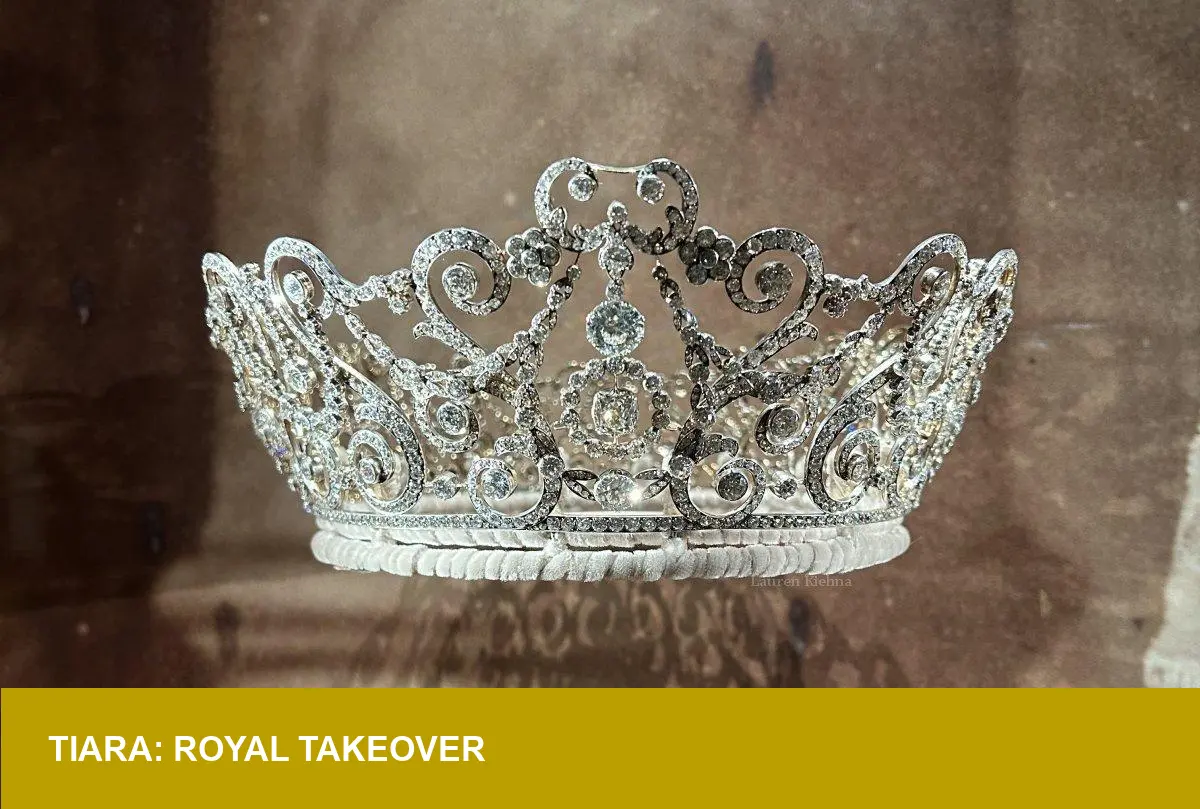
London’s spring exhibitions—Cartier at the V&A and The Edwardians at the King’s Gallery—put royal tiaras at the centre of 2025’s high-jewellery conversation, increasing exhibition provenance and renewed collector interest in historic diadems.
- Price: Not for sale — museum loans, public exhibition
- Carat weight: Varied; total caratage not publicly disclosed
- Origin: Royal Collection Trust and Cartier; pieces linked to Britain, Belgium, Monaco
- Date: April 2025 (Cartier at V&A; The Edwardians at King’s Gallery)
Context
Two concurrent museum presentations in April 2025 created an unusual market moment. Cartier’s retrospective at the Victoria & Albert Museum placed a lineup of firm-made diadems — from the convertible Bains de Mer setting to the Bonaparte olive-wreath — in public view. At Buckingham Palace, the Royal Collection Trust’s “The Edwardians: Age of Elegance” showcased a trio of crown jewels, capped by Queen Mary’s Delhi Durbar Tiara and Queen Alexandra’s kokoshnik, the latter presenting a dense “wall of diamonds” whose vitreous luster is almost architectural in effect.
These exhibitions did more than please visitors. They reanimated the objects as living fashion: pieces were removed from secure display to be worn at state banquets, and press previews amplified their cultural currency. In 2025’s market conversation — dominated by sustainability, provenance, and sculptural aesthetics — museum-backed visibility serves as a form of non-financial capital that frequently translates into market premiums for comparable historic jewels.
Highlights
The most discussed pieces were familiar names with renewed agency in the marketplace: the Delhi Durbar Tiara (1911), the Cartier Indian Tiara, the Aquamarine Pineflower Tiara, and the Girls of Great Britain & Ireland Tiara. Tactile details mattered to viewers: the pineflower’s aquamarines delivered a cool, crystalline counterpoint to the dense, substantial heft of the kokoshnik; the Bains de Mer’s ruby conversions demonstrated the mechanical ingenuity of early 20th-century high jewellery.
Why This Matters to US Retailers and Investors
For US buyers and sellers, the exhibitions signal three practical shifts:
- Provenance Premiums: Exhibition loans and state wear can materially elevate perceived provenance. Jewelry that appears in major museum shows often attracts stronger offers in private sales and at auction because institutional exposure reassures high-net-worth buyers.
- Design Direction: The demand curve is moving toward sculptural, wearable statements — kokoshnik silhouettes, convertible settings and architectural diamond bands. Retail assortments that lean into substantial, historical silhouettes will meet client appetite inspired by what they saw in London.
- Service Opportunities: Expect increased inquiries for vintage tiaras, high-jewellery rentals, and authenticated estate pieces. Retailers should prepare provenance documentation, condition reporting, and short-term rental packages for bridal and gala markets.
Practical Takeaway
Museum exposure does not equal immediate liquidity, but it does create a rarified halo. For investors, the lesson is selective: provenance built through public display and documented state wear can add a meaningful layer of value — particularly for pieces with clear maker attribution (Cartier) or royal provenance (Royal Collection Trust). For retailers, the opportunity lies in merchandising that references historical silhouettes and offering client services that translate exhibition interest into sales or rentals.
Further notes in this countdown will examine a wedding tiara moment and secondary-market reactions; contact us for detailed appraisals and exhibition provenance strategies.
Image Referance: https://www.thecourtjeweller.com/2025/12/the-best-royal-jewels-of-2025-6-a-royal-tiara-takeover-in-londons-galleries.html