
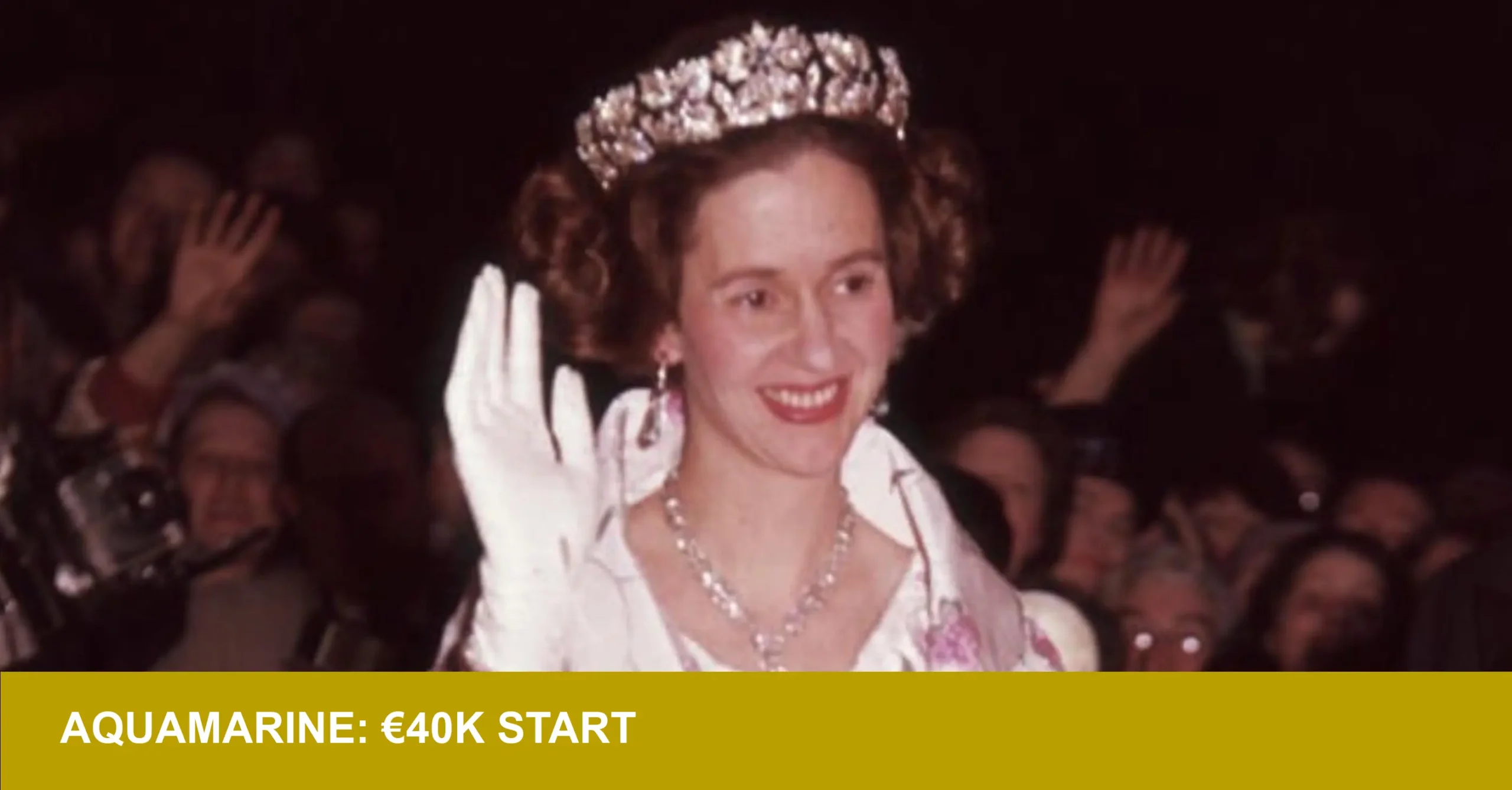
Queen Fabiola’s Art Deco demi‑parure — a platinum diamond sautoir, a detachable briolette aquamarine pendant and matching earrings from the late queen’s estate — is consigned to Ansorena in Madrid with a starting bid of €40,000. The lot combines museum‑scale scale stone weight and documented royal use, a combination that typically compresses market uncertainty into rapid collector interest.
- Price: Starting bid €40,000 (Ansorena, Madrid)
- Carat weight: Pendant: catalogue lists a large briolette aquamarine ≈120 ct; necklace diamonds ≈38.62 ct; earrings total ≈24 ct
- Origin: 1920s demi‑parure in platinum and yellow gold; mixed cuts including old brilliant, Dutch and 8/8 cuts
- Date: Sale scheduled Jan 2026 (Ansorena seasonal auction)
What the lot is, in hand
The ensemble reads as a working Art Deco demi‑parure: a detachable sautoir whose geometric openwork links show a refined vitreous luster in platinum, a pendant that fastens to the sautoir and terminates in a substantial briolette‑cut aquamarine, and long earrings in yellow gold and platinum finished with briolette aquamarines. The catalogue specifies screw‑back closures and the original A. Vega velvet and natural silk box — tactile evidence of careful retention rather than ad hoc dispersal.
Context: why this matters in 2025
In a market increasingly shaped by sustainability narratives and technical parity between natural and lab‑grown gems, provenance and sculptural presence are decisive. Lab‑grown diamonds have compressed price bands for unbranded stones; by contrast, large natural coloured stones — particularly briolette‑cut aquamarines with a pronounced vitreous luster and substantial heft — continue to attract premiums for confirmed natural origin and royal provenance. Collectors in 2025 are also paying up for convertible design and original fittings: this demi‑parure’s ability to reconfigure (sautoir to bracelets, pendant attachment) aligns with demand for sculptural versatility in high jewellery.
Impact for US retailers and investors
For a U.S. buyer or retailer the lot presents three actionable threads:
- Acquisition arbitrage: a €40,000 opening sits well below the replacement cost of a comparable period platinum sautoir plus a 100‑plus ct natural aquamarine. If provenance and condition check out, the lot could be marketed to private clients or specialty buyers at a substantial premium.
- Provenance as a multiplier: Queen Fabiola’s recorded use of the pieces at state events — the 1963 state visit to Britain and gala appearances tied to her wedding — increases institutional interest. U.S. dealers should secure documentation (photographic references, the A. Vega box) and obtain laboratory reports confirming natural origin and any heat treatment; those reports convert curiosity into retail price confidence.
- Commercial handling: plan for import duties, invoiced buyer’s premium, insurance for transit, and potential conservation. The long briolette should be inspected for internal cleavage or restoration; repolishing or resetting can erode provenance value if done without conservator oversight.
Practical next steps: request condition photos under raking light, demand a GIA/Gemological lab report that addresses natural origin and treatments, and confirm the precise auction estimate range from Ansorena. For retailers with private‑client programs, consider a quiet pre‑sale circuit — museums, royal‑collection specialists or established collectors who value documented royal wear — before committing to a public hammer strategy.
In short, this is not a jewellery lot defined by immediate liquidity. It is defined by documented use, convertible workmanship and an unusually large natural aquamarine that, once validated, makes the piece a provenance‑driven asset rather than a commodity stone.
Image Referance: https://royalwatcherblog.com/2025/12/29/queen-fabiolas-aquamarine-parure-going-on-auction/