
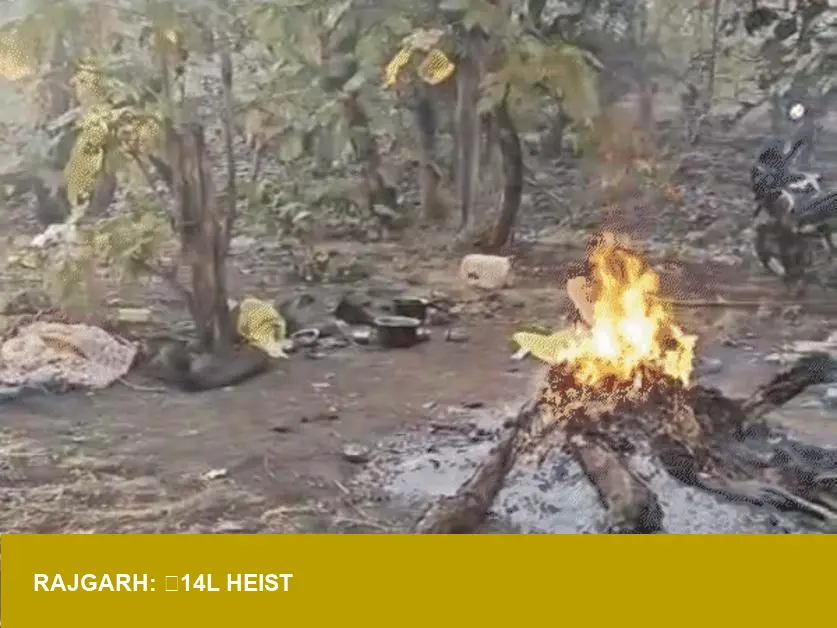
In the night of December 24–25, 2025, an armed gang struck Rajgarh’s Sarafa (jewellery) market, taking goods and cash valued at roughly ₹14 lakh. More than ten assailants moved methodically through the fort area, leaving traders injured and a market shaken; police later arrested three suspects after a protracted forest operation that exposed a crude hideout where wild boars had been butchered for food.
- Price: Approx. ₹14,00,000 (goods & cash recovered value)
- Weight: ~3 tola gold (~35 g) and ~1 kg silver seized/stolen
- Origin: Rajgarh Sarafa, Fort Area, Madhya Pradesh, India
- Date: Night of Dec 24–25, 2025
The lede: what happened and who was affected
The sequence began shortly after midnight as a cluster of thieves, armed with pistols, a crowbar and slingshots, forced entry into multiple shops in the jewellery lane. One jeweller reported about one kilogram of silver, three tola of gold and cash taken; CCTV was deliberately disabled. The group fired on pursuers and injured at least three locals before vanishing into the surrounding countryside.
The raid and the arrests
After two days of coordinated searching across dense forest in neighbouring Guna district, police launched “Operation Special 75.” Teams of officers worked in near‑zero visibility, fog and cold, covering roughly 20 kilometres over 40 hours. The strength was scaled to 225 personnel; three men were detained — identified locally as members of the notorious Pardi gang — while others escaped under cover of trees and mist.
The forest hideout: practical brutality
Investigators found the hideout stripped to essentials: makeshift bedding, a persistent bonfire and animal bones. More than six wild boars were discovered dead and hung from trees — portions missing, suggesting the group relied on hunted game for sustenance rather than venturing into villages. Recovered from the site: one firearm, 15 live cartridges, six motorcycles, slingshot pellets, theft tools and roughly ₹30,000 in cash.
How the theft unfolded in the market
The gang moved from shop to shop with a quiet, mechanical efficiency, damaging safes and cutting power to CCTV. An elderly pawnbroker survived an attempted breach by fastening an internal latch; other traders were less fortunate, sustaining blunt and ballistic injuries while chasing the robbers. Police have registered multiple cases: theft, robbery, attempt to murder and offences under the Arms Act.
2025 context: why this matters to the jewellery trade
In 2025 the industry has been pivoting on three axes — sustainability, traceability and the economics of lab‑grown gems — and this incident intersects all three. The raw, unsecured movement of low‑value bullion (silver, small gold pieces) remains an acute theft risk. Retailers increasingly prefer traceable supply chains and lab‑grown stones because they reduce transit of physical bullion and provide documented provenance. At the same time, the discovery of illegal hunting at the hideout raises regulatory and reputational risks for brands that source rural materials without thorough audits.
Immediate implications for US retailers and investors
For merchants and portfolio managers the lessons are practical and financial: reassess inventory mixes that favour numerous low‑margin, easily moved items; increase vaulting and timed transfers; tighten CCTV redundancy and remote monitoring; and demand supplier traceability down to the village level. Insurers will view recurrent small‑scale bullion thefts as an underwriting pressure point — premiums and deductibles can rise, squeezing margins on lower‑ticket lines.
Operational recommendations
- Prioritise clinically audited supply chains and certifications for bullion and gold source points.
- Shift assortments toward higher‑margin, lower‑volume sculptural pieces and authenticated lab‑grown stones to reduce transit risk.
- Negotiate insurance terms tied to demonstrable security upgrades (redundant CCTV, timed vault transfers, biometric access).
- Engage local law enforcement and community informers in sourcing regions as part of due diligence.
Final note
The Rajgarh incident is a blunt reminder that thefts no longer follow predictable patterns. The tactile reality — the dull metallic clink of stolen silver, the substantial heft of small gold parcels, the smoke‑scented bonfire in a makeshift hideout — should prompt the industry to marry aesthetic judgment with forensic security. For retailers and investors, the cost is measurable; the reputational risk may be greater.
Image Referance: https://www.bhaskarenglish.in/local/mp/news/rajgarh-dacoits-survived-by-hunting-eating-animals-wild-boars-found-hanging-in-jungle-overnight-police-operation-136821237.html