
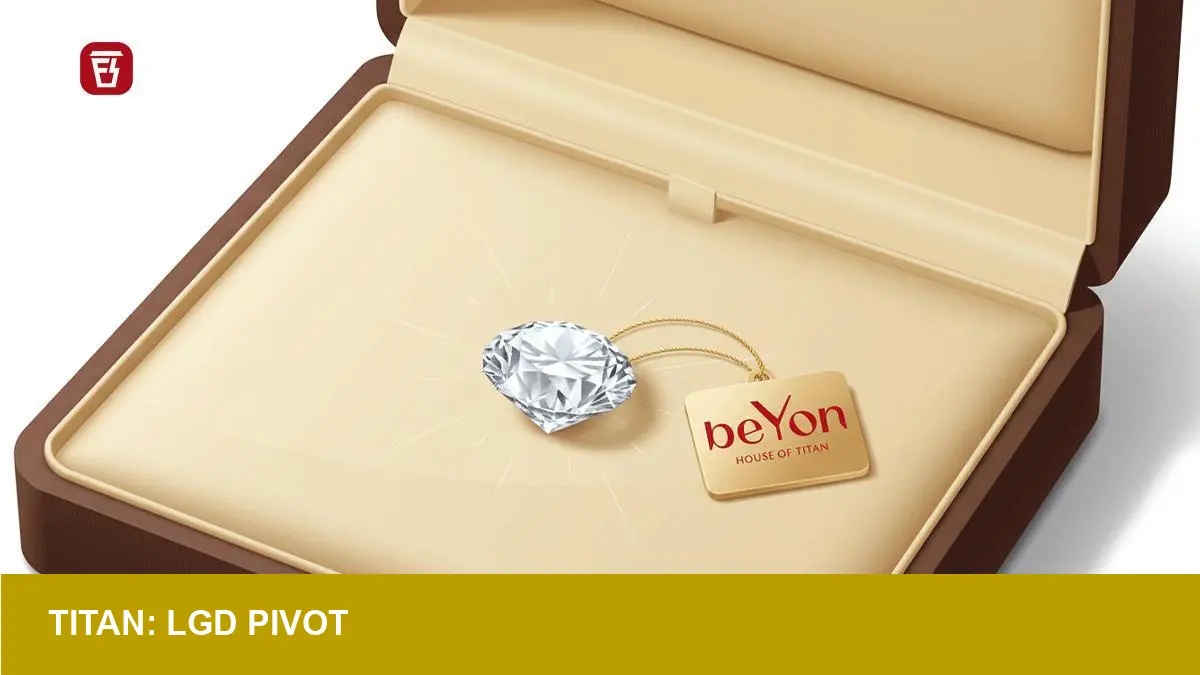
Titan’s beYon: a strategic pivot that moved the market
Titan has quietly opened beYon, a Mumbai storefront dedicated to lab‑grown diamonds (LGDs), and the move has immediate financial implications: the stock ticked to a 52‑week high as the company positions LGDs to protect jewellery margins while gold prices surge.
- Price: Entry point targeted at sub‑₹1,00,000 (consumer entry tier)
- Carat weight: Assorted—studs to solitaire‑size pieces; variable by design
- Origin: beYon flagship, Mumbai; product: laboratory‑grown diamonds
- Date: Launch reported early Jan 2026
What changed — and why now
Titan’s U‑turn is less a fashion statement than an economic calculation. Domestic gold has climbed sharply — roughly 77% year‑on‑year in 2025 — shifting many consumers from wearable gold to bullion or coins where the substantial heft of metal matters more than design. That behaviour hollowed out Titan’s lower ticket bands: the firm’s jewellery revenue still grew, with Q2FY26 up ~20% and EBIT up ~55% YoY, but buyer growth in plain gold fell around 11%.
LGDs sit between these forces. With a vitreous luster comparable to natural stones but at least ~40% lower price, lab‑grown diamonds let Titan re‑enter the sub‑₹1 lakh ticket band with finished, design‑led pieces — where margins are materially higher than raw bullion. In short: LGDs restore price‑sensitive buyers to a higher‑margin, consumption‑led category.
Trend alignment: sustainability, lab‑grown value and sculptural design
By 2025, market dynamics have two clear contours: sustainability and shifting value perceptions. LGDs carry a greener narrative — no deep‑earth extraction, clearer traceability — that resonates with Gen Z and younger millennials. Combined with the category’s ability to support more sculptural aesthetics (lighter settings, architectural mounts, tactile finishes), LGDs are a way to offer a different sensory proposition without eroding the premium identity of Titan’s natural diamond assortments.
Titan’s approach is deliberately segmented. beYon is not a renaming of Tanishq or Mia; it is a separate touchpoint designed to attract buyers who prioritise price, design and provenance over the investment story that underpins natural solitaires.
Why this matters to US retailers and investors
For US retailers and investors, Titan’s decision is a compact case study in margin preservation and portfolio segmentation. Key implications:
- Margin defence: LGDs allow established jewellers to protect gross margins when raw‑material prices spike by shifting the value proposition from metal weight to design and finish.
- Channel strategy: A separate brand/storefront maintains premium positioning elsewhere while capturing a distinct, younger cohort — a blueprint for multi‑brand retailing that preserves brand equity.
- Inventory & pricing playbook: Expect faster SKU turnover and a wider set of price points; LGDs reduce reliance on volatile natural‑stone supply chains and allow promotional flexibility without signalling distress in the natural market.
- Investor signalling: The move reduces exposure to cyclical bullion demand and to the high‑variance natural diamond market, smoothing revenue streams and preserving lifetime value from premium buyers.
Will LGDs cannibalise natural diamonds?
Unlikely in any material way. Natural‑stone buyers purchase exclusivity and perceived scarcity — attributes that retain value despite cheaper alternatives. LGDs expand the consumer pie by bringing a consumption‑first cohort into the brand ecosystem; over time some cross‑over may occur, but the two offerings meet different buyer psychologies.
Bottom line
beYon is a defensive, revenue‑accretive play: it offsets pressure from soaring gold while opening a younger, sustainability‑minded audience to design‑led jewellery at lower tickets. For retailers and investors studying global jewellery dynamics in 2026, Titan’s move underlines a simple lesson — segmentation preserves premium, and lab‑grown diamonds are the practical tool to do it.
Until next time…
Image Referance: https://finshots.in/markets/titans-u-turn-on-lab-grown-diamonds-2/