
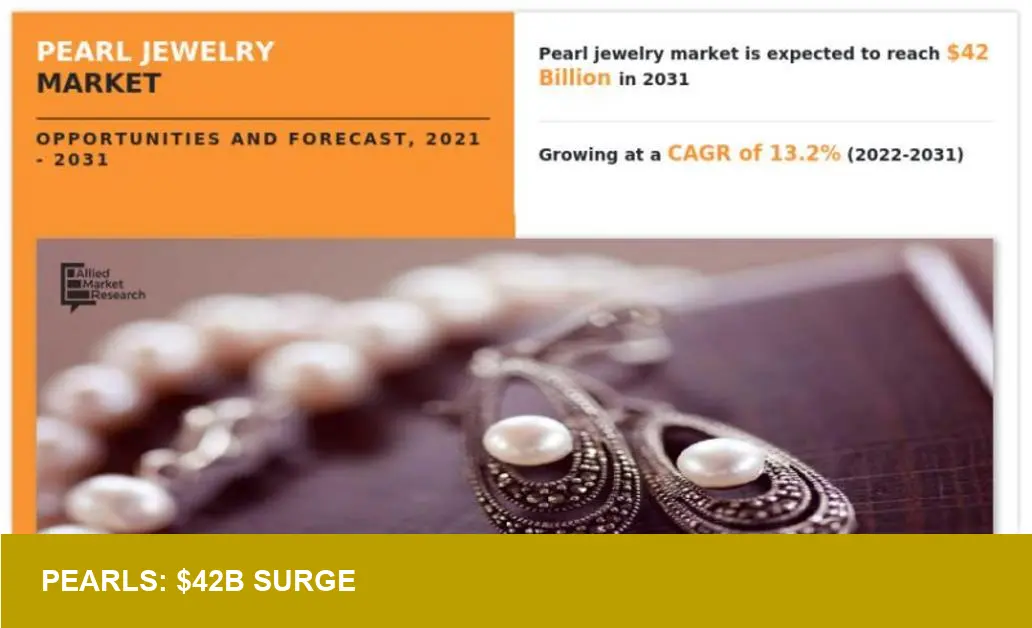
Pearl Jewelry Market — $42 billion by 2031. Allied Market Research projects the sector will expand from $12.8 billion in 2021 to roughly $42 billion by 2031 at a 13.2% CAGR, a shift driven by cultured-pearl supply, changing consumer demographics and the move to digital retail.
- Price: Market size $12.8B (2021) → $42B (2031 projection)
- Carat Weight: N/A — pearls measured in millimetres; product sizing varies widely
- Origin: Global market; Asia‑Pacific accounted for >40% of 2021 revenue
- Date: AMR projection span 2022–2031 (baseline data 2021)
Market mechanics: cultured supply, freshwater scale
The report places cultured pearls at the centre of growth. Cultured production—seeding mollusks to encourage nacre deposition—has expanded supply, particularly from freshwater farms where mollusks yield multiple pearls in a single cycle. That availability reduces unit costs and broadens price tiers, from satiny freshwater strands to rarer saltwater varieties with a more vitreous luster.
2025 trend lines shaping demand
Three dynamics converge as we approach 2025. First, sustainability and traceability: over‑cultivation risks and water‑quality pressures are prompting brands and suppliers to document provenance and husbandry practices. Second, product aesthetics shift toward sculptural, mixed‑media designs—pearls paired with textured metals or colored gemstones to provide contrast rather than pure ornament. Third, consumer composition is changing: male buyers and younger cohorts are adopting pearl rings and necklaces as part of a restrained, tactile wardrobe that values substantial heft and a quiet, satiny sheen.
Retail and investor impact in the US
For US retailers the data implies immediate, practical adjustments. Merchandise planning should widen price ladders: stocked freshwater strands and accessible silver‑set pearl pieces for volume sales, paired with small runs of saltwater and treated‑nacre items for margin. Online channels will continue to compress discovery and comparison—detailed imagery that conveys size in millimetres, nacre depth and surface quality will matter as much as price tags.
Investors should note concentration risk: Asia‑Pacific remains the dominant production and consumption region, so supply disruptions or regulatory shifts there can affect availability and pricing. Sustainable sourcing credentials and vertical integration—stakes in farms or certified suppliers—are differentiators with measurable upside in multiples as consumers increasingly value provenance.
Product and merchandising tactics
Operationally, buyers should prioritise: tighter SKU rationalisation to reduce inventory drag; marketing that uses tactile descriptors (satiny nacre, vitreous luster, measured millimetres) to translate sensory qualities online; and partnerships with select makers—Mikimoto, TASAKI, Jewelmer and regional specialists like Pearl Paradise—where brand equity supports premium pricing.
What to watch
Key inflection points: saltwater pearl yields and mollusk health, freshwater environmental management, the continued shift from offline to online distribution, and evolving gender norms in jewelry use. Each will influence margin structure and shelf allocation through 2031.
Players and landscape
AMR cites established houses and specialists among the active players: K. Mikimoto & Co., TASAKI, Jewelmer, Pearl Paradise and regional producers across Asia and Australia. Their strategies—celebrity partnerships, curated capsule drops and certification programs—illustrate how scale and storytelling convert supply into price resilience.
For US retailers and investors, the takeaway is straightforward: the pearl market’s expansion is substantive and measurable, but success will depend on disciplined sourcing, sensory‑accurate merchandising and clear sustainability credentials that translate to consumer trust and margin preservation.
Source: Allied Market Research (report summary published on openPR).
Image Referance: https://www.openpr.com/news/4337308/pearl-jewelry-market-size-to-exceed-usd-42-billion-by-2031-cagr