
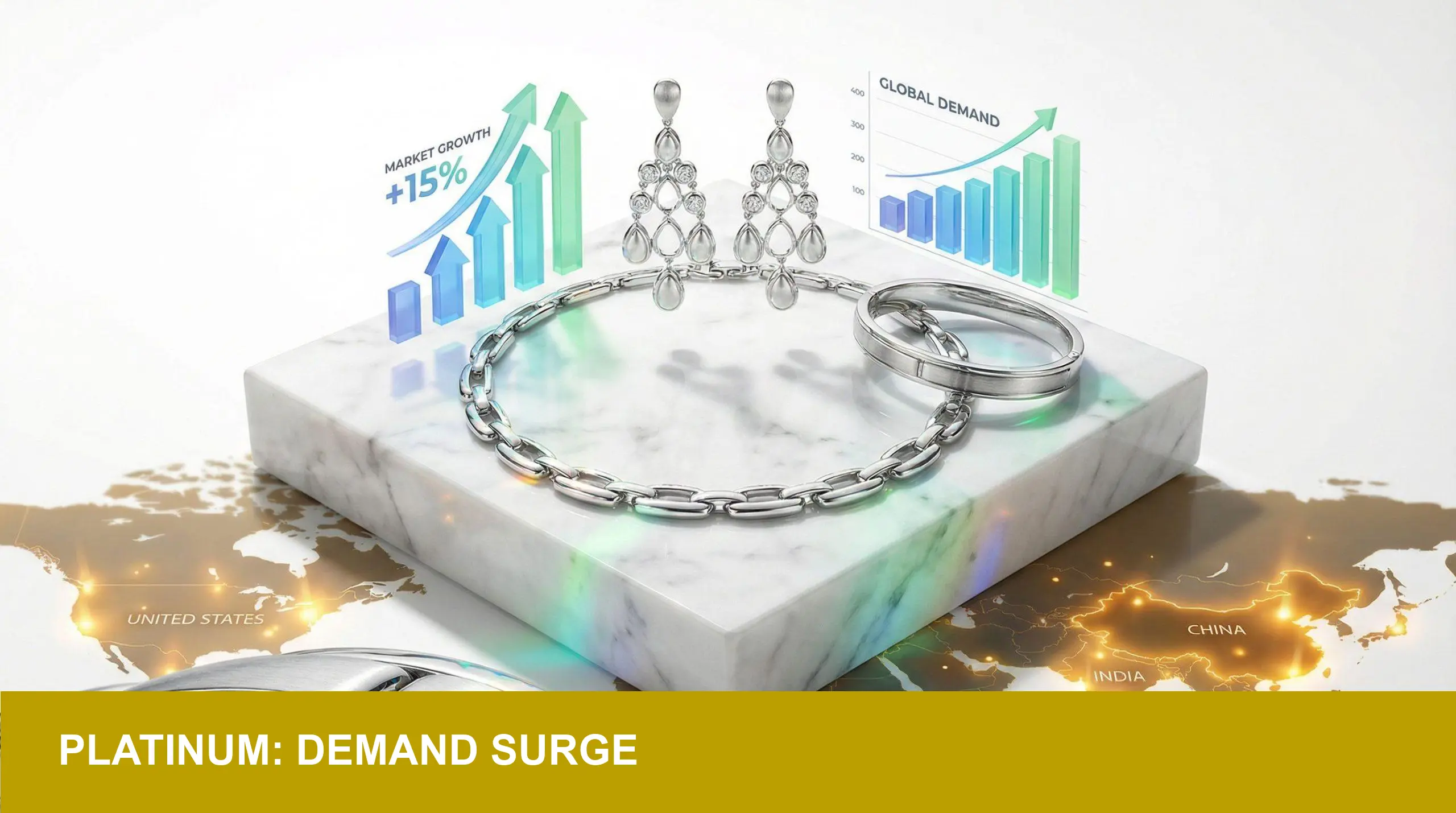
Platinum jewellery demand is rising as gold reaches record highs, creating measurable revenue upside for retailers and a strategic repositioning opportunity for investors. China’s fabrication surged 108% in H1 2025, India retail grew 8% year‑on‑year and U.S. revenues climbed in double digits—signs that substitution is translating into real value capture across markets.
- Price: Gold at record highs in 2025 (approx. $3,000/oz peak); platinum-to-gold ratio materially improved
- Carat weight: Not applicable (metal focus)
- Origin: Asia‑Pacific manufacturing expansion (China lead)
- Date: H1 2025 observed shifts; analysis current to early 2026
Economic forces and substitution dynamics
The immediate trigger is macro price divergence: as gold advanced to record levels in 2025, consumers became more price‑sensitive while retaining a desire for ‘true’ luxury. Platinum presents a tactile alternative — a cool, vitreous luster and substantial heft that read as premium without the sharp gold premium. That combination has created a substitution effect: consumers trade up in material quality while partially stepping around gold’s elevated price point.
Regional architecture: where demand is accelerating
Three regional trajectories explain the market shift.
- China: A 108% surge in fabrication in H1 2025 reflects both manufacturing confidence and retail pull‑through, especially in gem‑set applications where platinum’s natural white brilliance complements stones without rhodium plating.
- India: Systematic retail expansion and cooperative marketing drove an 8% year‑on‑year retail increase, with early gains in men’s jewellery and bridal categories where platinum is being reframed culturally.
- United States: Unit volumes softened under tariff and cost pressure, but average transaction value rose sharply — double‑digit revenue growth indicates effective premium repositioning rather than simple volume play.
Technical advantages that matter on the shop floor
Platinum’s material properties underpin its appeal in 2025: inherent white brilliance, resistance to wear and chemical degradation, and hypoallergenic, near‑medical purity standards (commonly 95%+). These are not marketing terms but tangible ownership benefits—lower maintenance, no rhodium replating, and a surface that retains its appearance through prolonged wear.
Manufacturing innovations — from improved alloys that ease workability to more efficient casting methods — have reduced production friction and enabled price points that make platinum a realistic premium alternative to white gold at scale.
2025 trend lines: sustainability, lab‑grown pairings and sculptural design
Three 2025 trends amplify platinum’s case. First, recycling and secondary‑supply integration improve the sustainability narrative and reduce net primary demand volatility. Second, platinum pairs well with lab‑grown diamonds and colored laboratory gems, matching their modern provenance story while preserving perceived value. Third, sculptural and tactile aesthetics — heavier pieces, broader bands and architectural settings — exploit platinum’s substantial heft and structural integrity, aligning product design with consumer desire for material presence.
Why this matters to U.S. retailers and investors
For U.S. retailers: reposition assortments to include mid‑to‑upper priced platinum offerings, prioritise gem‑set bridal and men’s categories where substitution is strongest, and communicate long‑term ownership savings (no replating, durable finish) in point‑of‑sale messaging. Inventory strategies should balance recycled supply access with hedging against metal volatility to protect margins.
For investors: the raw data — China fabrication +108%, India retail +8% YoY, U.S. revenue expansion — suggests structural demand uplift rather than a fleeting fad. Monitor the platinum‑to‑gold ratio, secondary supply trends, and alloy innovation adoption rates. Companies that secure recycled streams, forge partnerships with manufacturing leaders and capture premium share in bridal and gem‑set segments are positioned to compound value if gold remains elevated.
Risks and navigation
Risks remain material: a reversal in gold prices would reduce substitution momentum; regional policy changes and tariffs can compress margins; and consumer tastes can shift. Practical mitigations include agile sourcing, staged inventory commitments, and product differentiation through design and storytelling that foregrounds durability and purity rather than price alone.
This analysis reflects market data through early 2026 and focuses on how elevated gold pricing in 2025 has reshaped platinum jewellery demand. Retailers and investors should maintain active monitoring of price ratios and supply‑chain signals as the cycle evolves.
Image Referance: https://discoveryalert.com.au/platinum-jewellery-demand-2026-market-dynamics-innovation/