
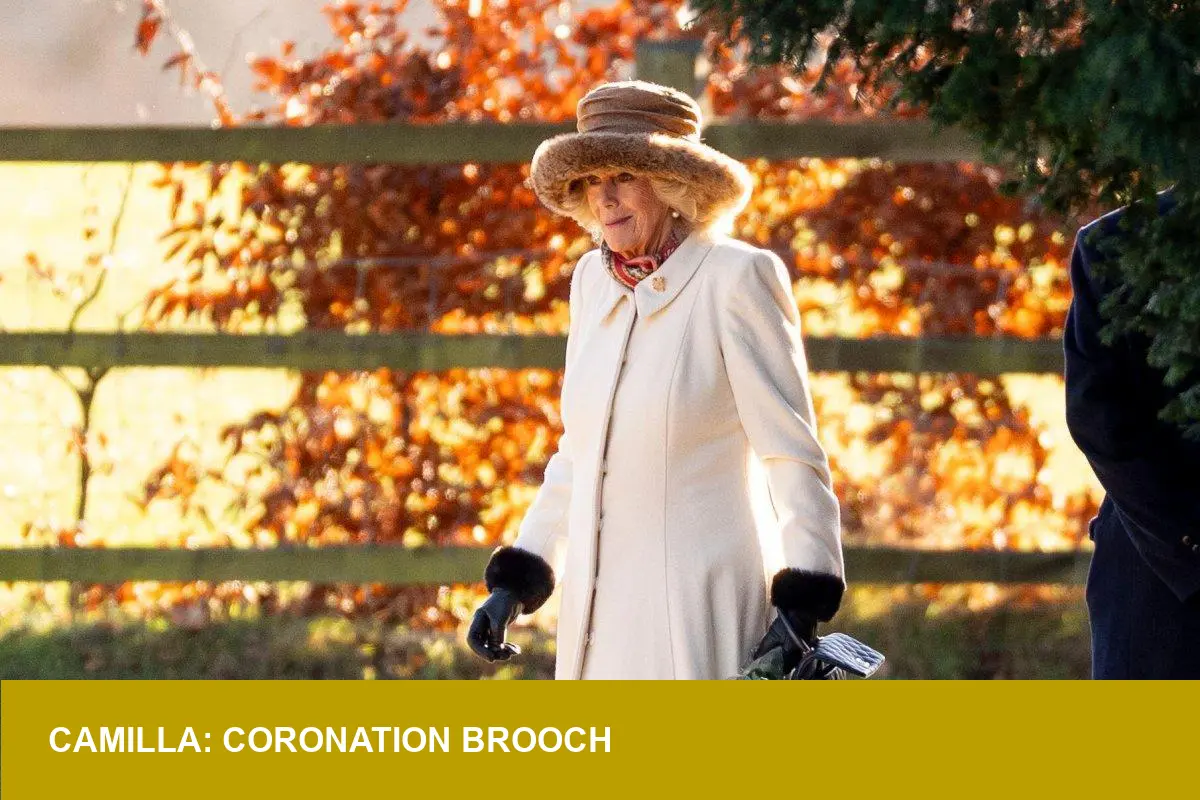
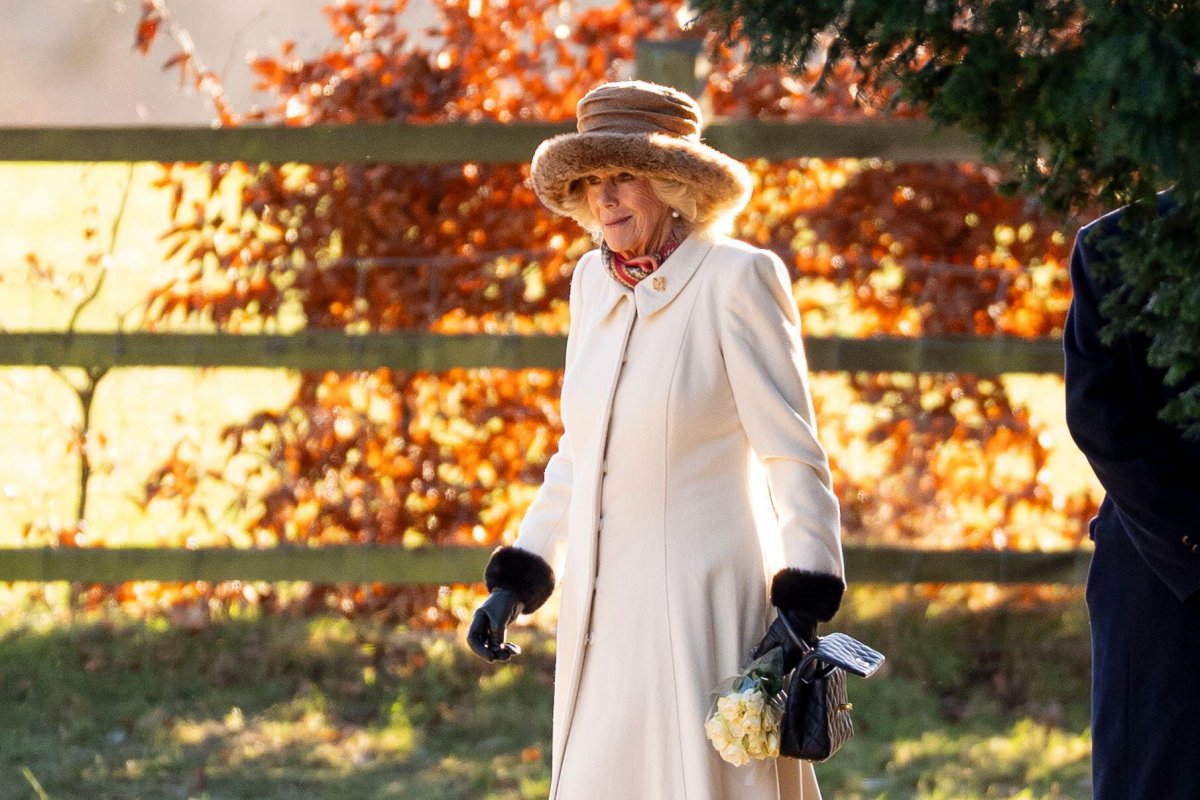
Queen Camilla attended church at St. Mary Magdalene, Sandringham, wearing a 1902 presentation coronation brooch whose royal provenance confers collectible value rather than a simple retail price.
- Price: Not publicly for sale / N/A (likely Royal Collection or private provenance)
- Carat weight: N/A — gold mount and tiny seed pearls (no single gemstone caratage)
- Origin: United Kingdom — created to commemorate the 1902 coronation of Edward VII
- Date: 1902 (presentation souvenir issued for the coronation)
What she wore
On January 4, 2026, Queen Camilla pinned a small presentation brooch to the collar of her winter coat as she and King Charles III walked to St. Mary Magdalene at Sandringham. The jewel is a diminutive Edwardian souvenir: curling gold numerals for the year, studded with tiny seed pearls whose vitreous luster reads as quietly opulent, and a heraldic Tudor crown finished with tactile vitreous enamel. The piece reads in the hand as miniature metalwork — compact, sculptural and surprisingly tactile when viewed close-up.
Historical context
The brooch type was produced as a presentation souvenir for the 1902 coronation of King Edward VII and Queen Alexandra. Numerous examples were made and distributed, so while the design is not unique, provenance is the differentiator. The brooch in Camilla’s rotation could be from the Royal Collection, a legacy piece linked to Alice Keppel, or a later acquisition; in any case, it has been part of her wardrobe since before Charles’s accession and has been seen at Buckingham Palace and Clarence House in public engagements.
2025–26 trends this underscores
Three market shifts intersect in a piece like this. First, provenance-driven demand: collectors and museums are placing a premium on confirmed royal provenance rather than on intrinsic caratage. Second, sustainability narratives: historical pieces function as durable, circular luxury—an alternative to newly mined goods and a complement to the rising lab-grown conversation. Third, sculptural aesthetics: buyers now prize small-format jewels for their micro‑sculptural detail and tactile presence rather than solely for gemstone size.
Why U.S. retailers and investors should take note
For U.S. retailers and investors, the story matters more than the sticker. Brooches tied to high‑visibility royal wear enjoy renewed attention after public appearances; that attention often translates into higher search traffic, stronger auction interest and a premium paid for documented provenance. Practical implications:
- Retailers can build merchandising around provenance — clear storytelling and verified history increase perceived value.
- Auction houses and private sellers should prioritise condition reports, photographic provenance and any archival references to unlock collector premiums.
- Investors seeking stable, low‑turnover assets may find historical royal pieces a defensible niche, particularly where supply is fixed and documentation is available.
Final note
The brooch is modest in scale but heavy in narrative. Its continued use by Queen Camilla amplifies interest in Edwardian presentation jewels as both cultural artifacts and collectible objects — an important reminder that in the current market, provenance and tactile craftsmanship often carry equal weight to carat figures.
Image Referance: https://www.thecourtjeweller.com/2026/01/an-antique-royal-coronation-brooch-for-queen-camilla-in-norfolk.html