
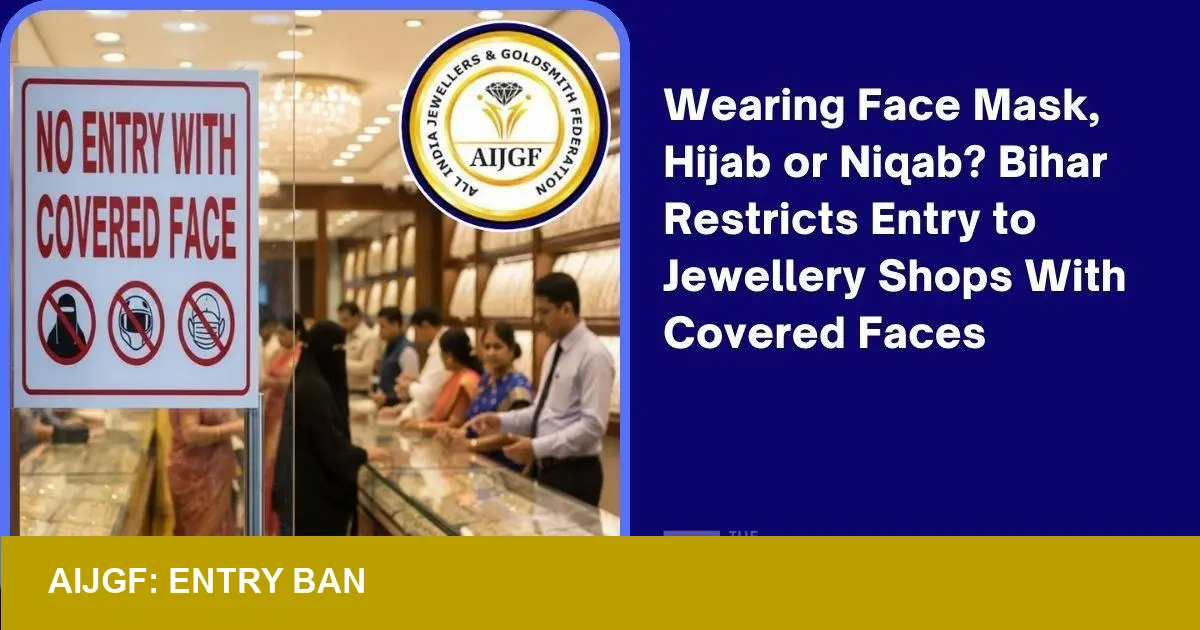
AIJGF enforces statewide “No Face Visibility, No Entry” at jewellery shops as gold reaches ₹1.40 lakh per 10 grams, citing a string of high-value heists that have exposed showrooms to organised theft.
- Price: ₹1.40 lakh per 10 g (gold); ₹2.5 lakh/kg (silver)
- Carat Weight: Not applicable — policy covers retail transactions across 22K/24K assortments
- Origin: Bihar, India (AIJGF state chapter)
- Date: Effective 7 January 2026
The Lede
The Bihar chapter of the All India Jewellers and Gold Federation (AIJGF) has instituted a statewide rule barring customers with covered faces — hijabs, niqabs, burqas, ghoonghats, masks and helmets — from entering jewellery showrooms. Framed as a measure to aid CCTV identification after a series of audacious heists (including a Bhojpur theft that yielded roughly ₹25 crore in ornaments), the directive links security to the rising market value and “substantial heft” of precious-metal inventories.
Context
Retail security and the precious‑metals market intersect here. With gold trading at a vitreous‑luster price of ₹1.40 lakh per 10 grams and silver near ₹2.5 lakh per kilogram, showrooms present concentrated stores of value that organised gangs increasingly target. Similar local rules have appeared in Uttar Pradesh towns; this is the first time a statewide federation has formalised such a policy.
That market reality sits alongside wider 2025–26 retail trends: growing emphasis on traceability and sustainability in sourcing, the steady market share gains of authenticated lab‑grown diamonds (which alter the theft calculus for gem‑led versus bullion inventories), and a move toward sculptural display strategies that reduce exposed inventory. Retailers balancing these pressures are rethinking how pieces of substantial heft are presented and protected without undermining customer experience.
The Political and Legal Backdrop
The rule has provoked a sharp political response. Opposition parties describe it as discriminatory and a breach of religious freedom; AIJGF leaders defend it as narrowly functional, not an attempt to ban religious dress. The sensitivity is heightened by earlier incidents involving removal of head coverings at public events in the state, making any clothing‑based directive a live constitutional and reputational issue.
Why This Matters to U.S. Retailers and Investors
For U.S. buyers, brands and investors with exposure to Indian manufacturing or retail partners, the directive signals three practical risks:
- Operational risk: Partner showrooms may change customer‑flow procedures, affecting conversion rates and in‑store experience.
- Reputational risk: Association with exclusionary policies can trigger consumer backlash in global markets that prioritize inclusion and brand ethics.
- Insurance and loss exposure: Rising bullion prices and concentrated in‑store inventories can increase premiums and deductibles; insurers will expect demonstrable security protocols.
Practical Alternatives and Best Practice
Security for high‑value retail need not default to blanket prohibitions. Measures that balance identification with dignity — private verification booths, female staff for face checks, appointment‑only viewings, or staged display that emphasises sculptural presence rather than open counters — can reduce theft risk while limiting legal and reputational fallout.
Technically, investments that modernise perimeter CCTV (higher‑resolution optics and better lighting to capture vitreous luster and fine detail), integrated alarm systems, and tamper‑resistant display cases often deliver better loss‑prevention per rupee than customer bans. For investors, contract language should require partners to maintain non‑discriminatory security processes and documentation of staff training.
The Bottom Line
Bihar’s federation has chosen a blunt operational response to a clear market stimulus: record precious‑metal prices and organised theft. The rule will reduce anonymity in showrooms, but it opens legal and brand‑reputation fault lines that regional and international stakeholders must monitor. For retailers and investors, the prudent path is layered security that preserves customer dignity while protecting inventories of substantial heft and enduring value.
Further Reading
See reporting on local precedents and the broader debate over identification and religious freedom in retail settings.
Image Referance: https://thelogicalindian.com/wearing-face-mask-hijab-or-niqab-bihar-restricts-entry-to-jewellery-shops-with-covered-faces/