
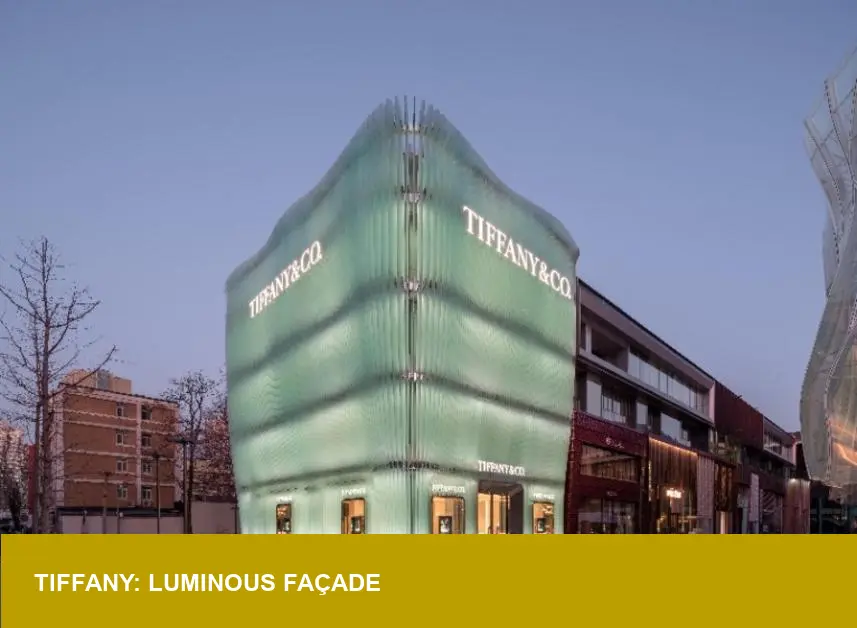
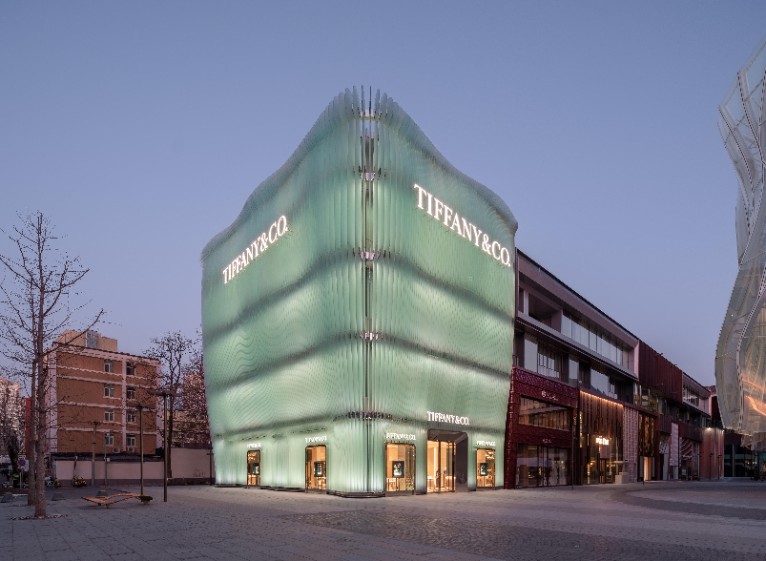
 Tiffany & Co. has opened a four‑storey flagship in Beijing’s Taikoo Li Sanlitun district whose MVRDV‑designed façade of vertical, translucent glass fins turns the building into a refined, luminous object — a brand‑level investment that strengthens premium retail positioning while embedding lifecycle value through demountable construction.
- Price: Undisclosed (estimated multi‑million development)
- Carat Weight: N/A — four storeys of vertically layered glass fins (architectural scale)
- Origin: Taikoo Li Sanlitun, Beijing
- Date: Opened 2025
Architecture Inspired by Jewellery
The façade is a soft, sculptural envelope made from vertically arranged, gently curved glass fins whose vitreous luster and subtle translucence translate the sensual geometry of Elsa Peretti’s Bone Cuff into urban scale. From distance the surface reads as continuous; up close it becomes porous, offering glimpses of display and interior light — a choreography of concealment and reveal that privileges craft over signage.
Light as a Design Material
MVRDV deploys light as a primary material. The dense layering amplifies reflection and refraction so the façade shifts its character with viewpoint and time of day. At night the natural blue tone of the selected glass is illuminated in Tiffany Blue®, producing a diffuse glow that animates the street without theatricality. Lighting modules sit in custom brackets, intentionally unseen so the play of light remains the focal point.
A Demountable and Responsible Façade
Beyond its tactile presence, the system is conceived for circularity: locally manufactured, responsibly recycled glass fins and demountable fixings allow reuse or recycling at end of life. That duality — permanence in presence, adaptability in assembly — positions the façade as both a luxury gesture and a practical asset in an era where lifecycle cost and material provenance affect brand value.
Context: 2025 Retail Trends
In 2025, the most consequential retail investments are those that marry sculptural aesthetics with measurable operational benefits. Demountable façades answer two pressures at once: experiential differentiation for affluent customers and ESG‑aligned design that reduces long‑term waste. The Tiffany/MVRDV pairing continues a recent lineage of architects reimagining storefronts as three‑dimensional brand signals rather than mere billboards.
Impact for U.S. Retailers and Investors
For U.S. retailers and investors, the Beijing façade is a compact case study in how design amplifies commercial value. A carefully composed exterior increases footfall and dwell time, supports premium rent negotiations, and reduces future renovation costs if elements are designed to be demounted and reused. Equally, provenance — recycled materials, local manufacture — is increasingly priced by tenants and capital markets as part of an asset’s ESG profile.
Jacob van Rijs, founding partner at MVRDV, summed the intent: “When viewed from an angle, the layering effect of the dense glass fins amplifies the effects of the light, highlighting the façade’s shape. The light filtering through and reflecting off the translucent glass creates a delicate interplay that is constantly changing as you move. And, as you pass close to the building, you see glimpses in between the fins to the jewellery inside.” The result is a building that behaves like jewellery — revealing richness through proximity and detail.
Why This Matters
As flagship strategies evolve, physical stores must offer more than merchandise; they must be tangible extensions of brand equity. MVRDV’s fifth façade for Tiffany & Co. demonstrates how material choice, light handling, and circular detailing can convert architectural expression into measurable commercial advantages — a model U.S. operators will watch closely as they balance experiential ambition with longevity and ESG obligations.
Images © Tiffany & Co.
Image Referance: https://www.archilovers.com/stories/30746/jewels-in-motion-mvrdv-s-tiffany-co-facade-shimmers-in-beijing.html