
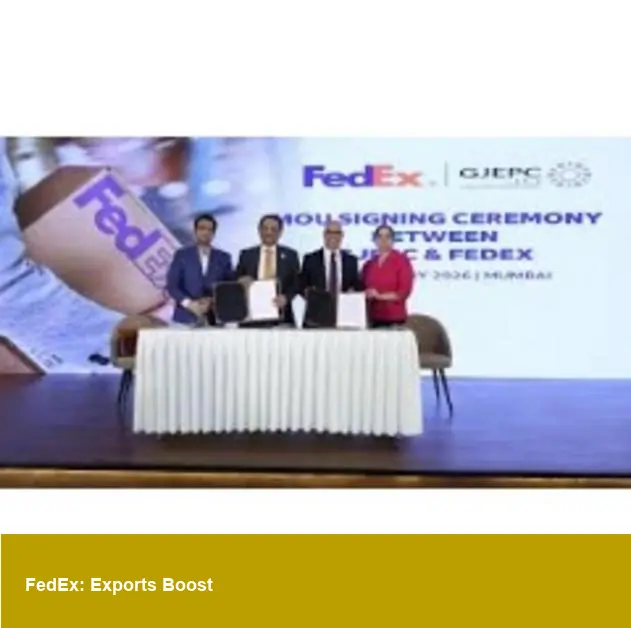
FedEx and GJEPC formalize a logistics pact designed to reduce shipment uncertainty and unlock additional export revenue for India’s gems and jewellery sector.
- Price: Not applicable
- Carat Weight: Not applicable
- Origin: Mumbai, India
- Date: January 14, 2026
Federal Express Corporation (FedEx) and the Gems & Jewellery Export Promotion Council of India (GJEPC) signed a Memorandum of Understanding in Mumbai on January 14, 2026. The accord pairs FedEx’s time‑definite international services and digital visibility with GJEPC’s export network, targeting improved shipment predictability that underpins higher realized prices and faster market access for exporters that together represent 6.8% of India’s merchandise exports.
Context
The partnership arrives amid a 2025‑era shift where logistics reliability is as material to value as gemstone grade. Supply‑chain predictability now determines inventory turn, margin compression and the speed at which new design narratives — including lab‑grown diamonds and sculptural, heavy‑set pieces — reach U.S. retailers and global buyers. FedEx brings 36 weekly flights through Mumbai, Delhi and Bengaluru, connecting exporters to markets that account for more than 99% of global GDP, and bolsters local capacity with investments such as the Bengaluru AI SATS integrated hub.
For makers and small exporters, the MoU promises more than door‑to‑door carriage: structured knowledge‑sharing (seminars, webinars, focused engagements) and integrated customs solutions aim to reduce dwell time and compliance friction. That operational smoothing gives exporters a more tactile advantage — shipping with a measurable, almost tangible reduction in transit uncertainty and greater end‑to‑end visibility.
Impact for US Retailers & Investors
U.S. retailers sourcing from India should view the agreement as a structural improvement in supply‑chain certainty. Reduced transit volatility supports leaner inventory, faster replenishment and more precise merchandising windows for seasonal and trend‑led assortments. For buyers handling high‑value pieces, FedEx’s time‑definite lanes and predictability lower the working‑capital drag associated with long transit queues and customs variability.
Investors should note two implications. First, logistics enablement de‑risks a major export market: steadier flows increase revenue visibility for Indian suppliers and raise the investability of vertically integrated manufacturers. Second, services and digital infrastructure — analytics, AI planning and visibility platforms — are value drivers in their own right; they compress risk premiums on cross‑border trade and make export‑oriented MSMEs more bankable.
In sum, the FedEx‑GJEPC MoU is a supply‑chain intervention with measurable market effects: better predictability, clearer compliance pathways and a faster path from atelier to showroom. For U.S. buyers and capital allocators, that translates into lower inventory friction and clearer demand signals from one of the world’s largest gems and jewellery manufacturing hubs.
Press image: https://photos.webwire.com/prmedia/6/349170/349170-1.jpg
Image Referance: https://www.webwire.com/ViewPressRel.asp?aId=349170