
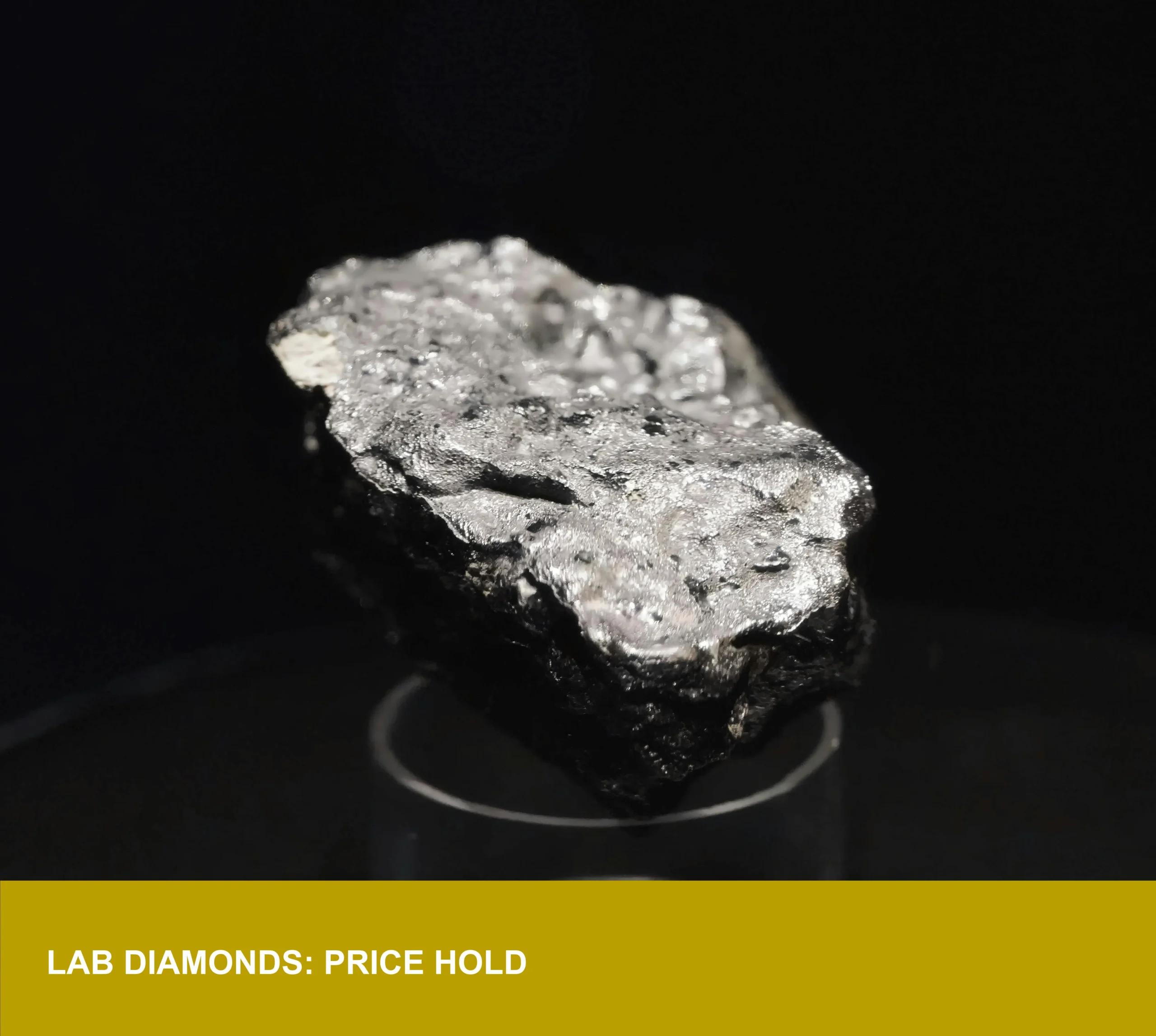
Who: The laboratory producers and traditional jewelry houses. What: Despite identical chemistry and optics, lab-grown diamonds have not collapsed retail pricing. Financial impact: Natural stones continue to command 70–90% premiums and leave lab-grown pieces exposed to faster depreciation — a structural challenge for U.S. retailers and investors.
- Price (example): 1.00 ct lab-grown brilliant — ~$2,000 retail; equivalent natural — ~$6,000–$12,000.
- Carat weight: 1.00 ct (illustrative comparative).
- Origin: CVD / HPHT reactors (major production hubs: China, India, Singapore, U.S. labs).
- Date: January 2026 market read.
The Lede: Why scarcity didn’t vanish with the reactor
Laboratory-grown diamonds are chemically, physically and optically indistinguishable from earth-mined stones. Yet the market still prices them differently. The divergence is less about atoms than about narrative, certification, manufacturing overhead and resale psychology. Retail tags therefore reflect more than the crystal — they price infrastructure, story and perceived store-of-value.
Fast facts that keep margins intact
Putting a vitreous-luster stone on a velvet tray costs more than the rough. The visible price gap between lab and natural stones is underpinned by three tangible factors:
- Manufacturing scale: CVD and HPHT reactors require continuous operation, advanced vacuum systems, high-energy microwaves or million-pound presses, and seed crystals — all of which carry elevated capital and electricity costs.
- Grading and provenance: Certification from GIA, IGI or equivalent, laser inscription and the paperwork trail impose fixed fees that set a retail floor.
- Retail overhead and risk: Insurance, security, trained sales staff and showroom operating costs are identical regardless of origin and are added to the product price.
Context: 2025 trends shaping 2026 pricing
The market has entered a post-hype phase. In 2025 the industry pivoted from volume growth to value management — a response to three concurrent trends:
- Sustainability premium: Consumers increasingly buy on impact. Brands that clearly quantify lower CO₂ and human-rights exposure capture an ethical uplift that softens price compression.
- Lab-grown value erosion: Continued improvements in reactor efficiency have driven down wholesale costs for lab stones, but that decline is often absorbed by retailers rather than passed fully to consumers to protect margins.
- Sculptural and design-led demand: Buyers are paying for the object — substantial heft, refined mounting and sculptural metalwork — not just the carat. That elevates the finished piece above raw stone cost considerations.
The manufacturing economics beneath the sheen
It’s easy to assume that a lab stone is cheap because there’s no shovel involved. In practice the expense profile shifts from extraction to engineering. Continuous-power reactors, climate-controlled clean rooms, and a small cadre of materials scientists and lapidaries keep unit economics elevated at boutique and mid-tier volumes. R&D amortization and seed-crystal logistics further narrow the gap between production cost and retail price.
Grading, certification and the resale calculus
Both mined and lab-grown diamonds go through the same Four Cs analysis. That process — from expert graders to laser inscription — is fixed. But the secondary market treats them differently. Lab-grown stones face faster functional obsolescence: incremental improvements in production mean a stone bought today can be materially cheaper to replicate in a few years. For retailers, that translates to inventory risk; for investors, to a weaker store-of-value case.
Colored stones: when imperfections become value
Rubies, sapphires and emeralds illustrate a different dynamic. Many collectors prize natural stones precisely because of their internal character — a fractured “garden” or mineral fingerprint that gives a stone a tactile, identifiable presence. Where lab synthesis produces clinical clarity, natural inclusions can convey provenance and justify premiums.
Ethics as pricing lever
Ethical provenance is now a monetizable attribute. Brands that can document lower environmental impact and demonstrate traceable, fair-labor upstreams realize an “ethical premium”. This is particularly relevant to younger buyers for whom demonstrable sustainability can validate paying above raw production cost.
What this means for U.S. retailers and investors
Retailers should treat lab-grown stones as a distinct product category with its own margins, warranties and messaging. Practical steps include:
- Segmented inventory: keep lab-grown assortments separate, with clear certification and differentiated after-sales pricing.
- Margin engineering: price to reflect grading fees, overhead and accelerated depreciation; avoid treating lab-grown pieces as identical to mined goods for buyback or trade-in policies.
- Story discipline: lean into measurable sustainability claims, manufacturing provenance and design craftsmanship rather than competing on raw stone price alone.
For investors the takeaway is binary: natural stones remain a scarcity play with asymmetric upside in the upper quartile of quality; lab-grown diamonds are a technology play exposed to efficiency gains and price compression. Portfolio allocation should reflect that risk asymmetry rather than treating all gemstones as equivalent assets.
Bottom line
Prices didn’t survive on mystique alone. They endure because of real costs — engineered production, certification, retail risk and a market willing to pay for certainty and story. In practice, a stone’s value is a composite of its molecular composition and the systems that give it provenance and market standing. For U.S. merchants and investors, that means adjusting pricing, inventory and messaging to a two-track market: one track for finite, earth-mined scarcity and another for rapidly evolving lab-grown supply.
Sources: GIA; Bain & Company Global Diamond reports; FTC jewelry marketing guidance; industry interviews, 2025–2026.
Image Referance: https://vocal.media/fyi/why-are-gemstones-still-expensive-if-we-can-grow-them-in-a-lab