
Second headline: Luxury groups, from LVMH to independent footwear houses, are already reallocating price architecture and experience budgets as a K-shaped economy concentrates spending at the top and value tiers — a shift with direct margin and inventory consequences for retailers and investors.
- Price (AOV): Record-high average order values reported at Mytheresa (Nov–Dec 2025)
- Carat Weight (Market share): Shoes under $250 now account for 42% of market share (Joor, 2025)
- Origin: Company earnings and sector reports — LVMH, Kering, Richemont, Joor, LuxExperience, Placer.ai
- Date: Nov–Dec 2025 earnings cycle; forecasts through 2026
What’s happening
The K-shaped bifurcation — rising spend at the wealthiest households, steady performance in the value segment and erosion of the middle — is no longer an academic construct. Executives from Burberry to Richemont described a marketplace that is “very bifurcated,” with momentum concentrated in high-ticket categories and well-curated value plays. The immediate financial implication is simple: stronger full-price sell-through and upward pressure on average order values at the top; compression and margin pressure in mid-market assortment.
Signals from the quarter
Luxury conglomerates flagged disciplined pricing and better full-price sell-through; Richemont noted particularly resilient demand in jewelry, where pieces carry a vitreous luster and a structural premium that appeals to wealthier buyers. LuxExperience attributed growth at Mytheresa to “big‑spending wardrobe‑building customers,” while wholesale data from Joor shows a clear volume shift — footwear priced under $250 now owns 42% of the market, as the $500–$1,000 tier weakens since 2021.
At smaller houses, the response is tactical: Malone Soulier is rebalancing toward accessible flats while preserving made‑to‑order and bridal lines for clients seeking personalization and prestige. That dual approach — accessible entry points plus high‑margin bespoke offerings — is becoming an operational template.
2025 trends that matter
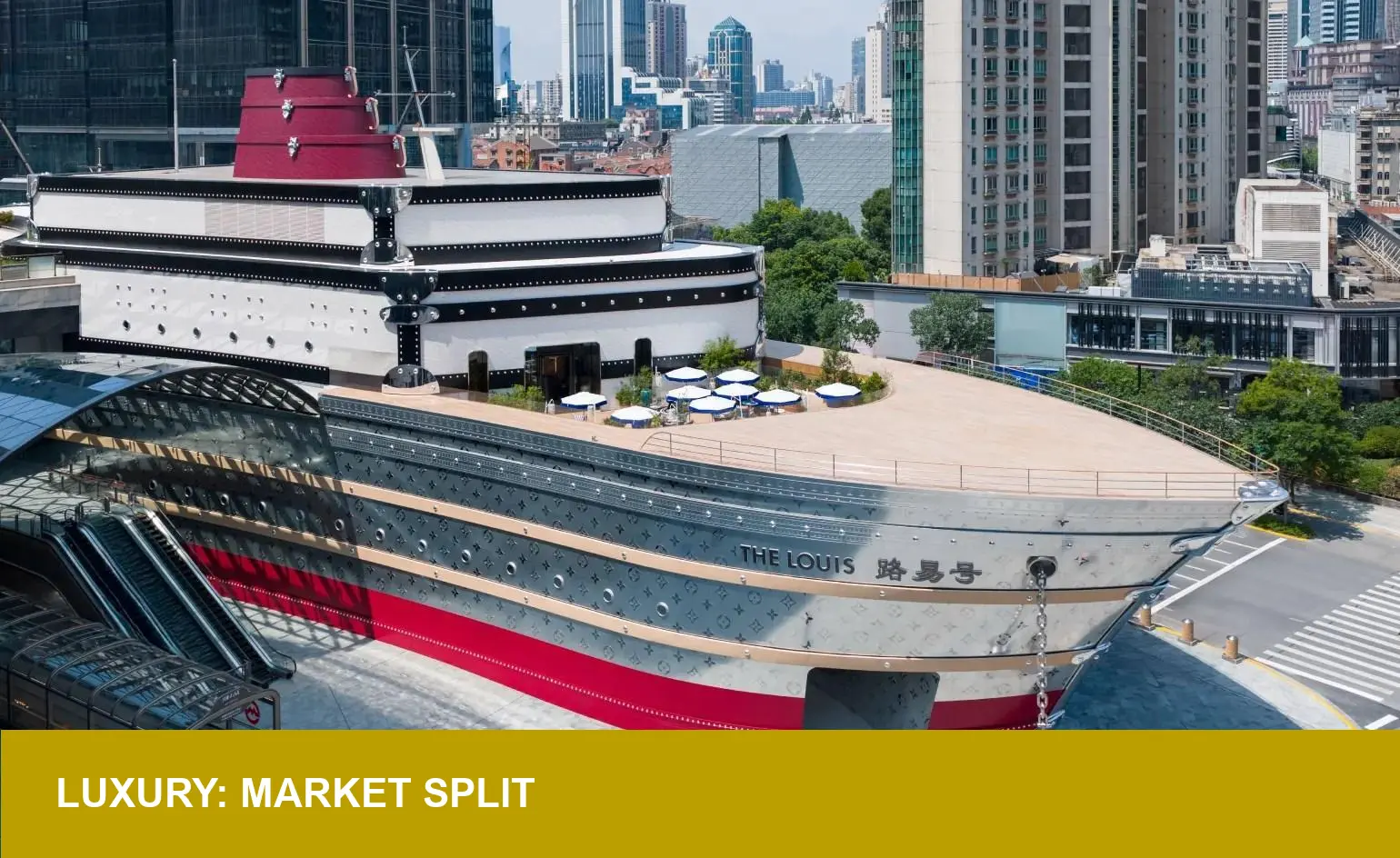
This polarization aligns with three structural trends shaping luxury into 2026. First, experiential retail: spectacle and cultural programming (Louis Vuitton’s Shanghai ship‑like flagship, The Louis, and the brand’s 2026 hotel on the Champs‑Élysées) convert non‑buyers into brand advocates, lowering the activation cost of future high‑value customers. Second, inclusive exclusivity — quality items at accessible price points that still convey prestige — are functioning as long-term funnels. Third, sustainability and alternative value propositions (including lab‑grown gems in select categories and transparent craft narratives like Hermès’s Carré H) are reframing entry‑level trust without diluting brand cachet.
Why US retailers and investors should care
For US merchants this is a strategic inflection: the middle is no longer a safe refuge. Tactical implications:
- Inventory discipline: prioritize full‑price sell‑through metrics and shorten replenishment cycles for middle‑priced SKUs to avoid markdown drag.
- Channel and experience investment: convert storefronts into curated cultural stages — cafés, galleries, and events — to build the tactile connection that precedes big‑ticket purchases.
- Segmentation and personalization: maintain VIP lists and deepen made‑to‑order capabilities; the substantial heft of top‑end AOVs rewards tailored service.
- Sustainability as selective premium: incorporate transparent sourcing and lab‑grown pathways where they enhance accessibility without undermining provenance for high‑end buyers.
Bottom line
The K‑shaped economy is forcing choices: double‑down on the top and on trusted value, or risk being squeezed in the middle. Brands that preserve an aura of exclusivity while providing tactile, lower‑risk entry points — thoughtful cafés, craft‑led exhibits, or affordable premium pieces — will command both attention and margin. For investors, the signal is equally clear: allocate toward disciplined luxury operators with strong full‑price sell‑through, robust experiential footprints and flexible assortment strategies that can capture both the vitreous luster of high jewellery demand and the steady volume of the value segment.
Image Referance: https://www.glossy.co/fashion/luxury/the-k-shaped-economy-is-forcing-luxury-brands-to-pick-a-side/