
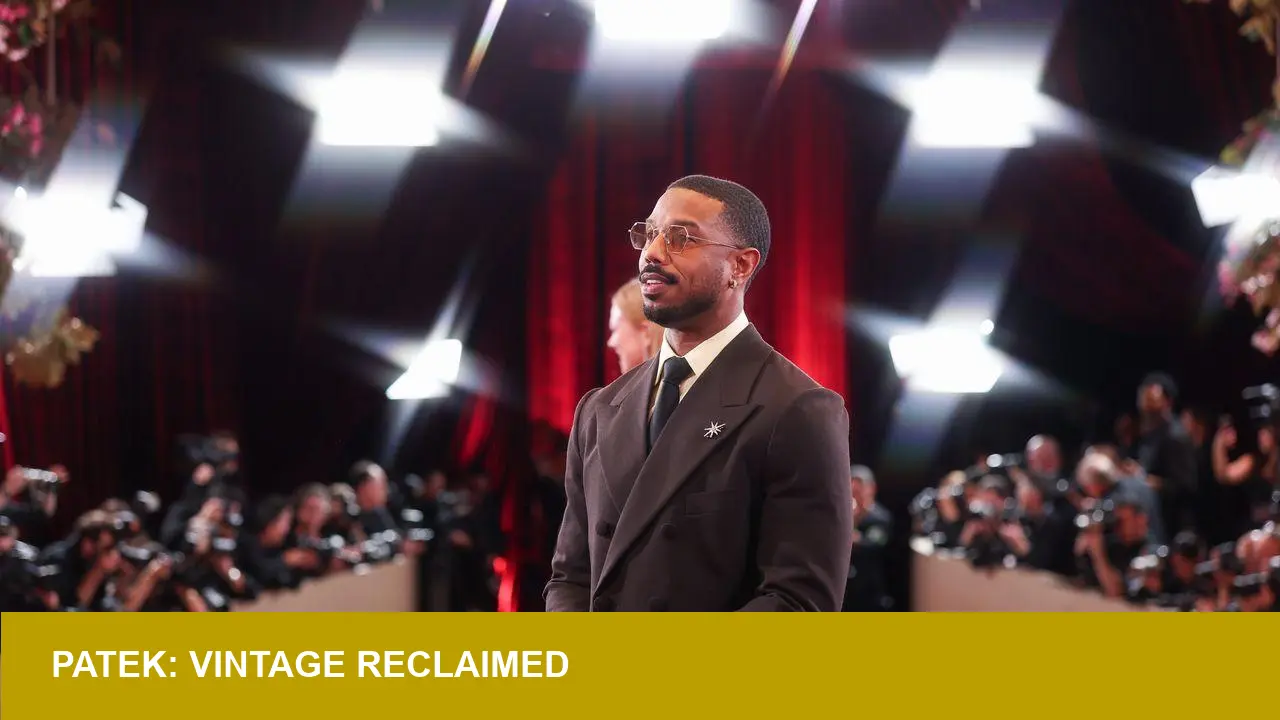
Jason Bolden, the stylist behind Michael B. Jordan and Ryan Coogler at the 2026 Golden Globes, framed two award-night looks that carry tangible market signals: Jordan’s re-acquired vintage Patek Philippe and Coogler’s Marli diamond brooch. These objects—wristwear with a lived patina and a brooch with vitreous luster—underscore rising appetite for authenticated vintage and fine jewelry with provenance, pushing secondary-market premiums for well-documented pieces.
- Price: Vintage Patek Philippe — estimated mid-five to low-six figures (reacquired at private sale/auction round); Marli brooch — retail-equivalent estimate: low five figures (unconfirmed).
- Carat Weight: Marli brooch — not publicly disclosed; appears to be knife-edge melee and single-cut accents rather than a single large carat stone.
- Origin: Patek Philippe (Swiss); Marli (New York); tinted glasses sourced from a family-owned boutique in Japan.
- Date: Golden Globes appearance — January 11, 2026 (styling and acquisition context cited by Jason Bolden to GQ).
Context: How wardrobe choices became market signals
The choice to foreground a vintage Patek over a modern release is not purely sartorial. In 2025 the secondary market for watches and branded jewelry tightened: collectors favored pieces with visible history—the substantial heft of an older steel case, a warm caseback patina, unique dial aging—because those attributes provide irreplaceable scarcity. Simultaneously, lab-grown diamonds and responsible sourcing conversations nudged buyers toward items with clear provenance; an original brooch from a New York atelier carries narrative value that lab-grown equivalents struggle to replicate.
Bolden’s direction—with brown Prada suiting that references a 1930s silhouette and Thom Browne restraint for Coogler—also reflects the sculptural- tailoring trend that dominated 2025: jewelry and watch choices are curated to read against silhouette, not merely to decorate. The effect is tactile: a watch that has a noticeable, reassuring weight on the wrist; a brooch whose vitreous sparkle reads across camera flashes. That sensory certainty amplifies perceived investment value.
Impact: What U.S. retailers and investors should note
For U.S. jewelers and pre-owned dealers, the takeaways are operational. First, authenticated provenance now materially affects resale multiples. A documented chain of ownership—stylist involvement, auction provenance, or celebrity re-acquisition—creates a premium that can outpace conventional markdown strategies. Second, merchandising should foreground tactile language and sensory cues in listings: note patina, case heft, and original box/papers; provide macro photography that captures vitreous luster and mounting details.
Third, partnerships with stylists and cultural gatekeepers are proving an efficient pipeline to demand. When a high-profile stylist places a vintage watch or a converted brooch on a red carpet, interest radiates into bidding rooms and boutique inquiries. Retailers should consider curated private-sale programs, certified pre-owned windows, and limited edit drops timed to awards season to capture immediate uplift.
Finally, inventory strategy must balance lab-grown and natural stones more deliberately. Natural diamonds with documented provenance and distinct design lineage (such as Marli’s reworked brooch) are increasingly viewed as collectible statements rather than commodity stones—supporting differentiated pricing and targeted investment messaging.
As Bolden turns his attention toward the Oscars, expect more vintage finds and artisanal fixtures to appear on red carpets—each placement a subtle market test for what collectors will pay to own a piece of that narrative.
.jpg)
Image Referance: https://www.gq.com/story/golden-globes-2026-michael-b-jordan-ryan-coogler-stylist-behind-the-scenes