
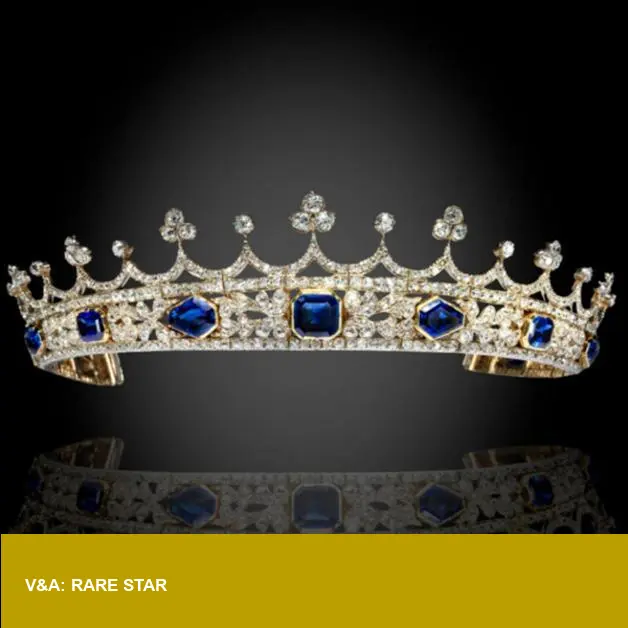
Dynastic Jewels: V&A and Al Thani bring 100+ royal gems to Paris — a reminder that provenance still commands premium value.
- Price: Not for sale — museum loans
- Carat weight: 57.31 ct (Star of Golconda); ensemble weights vary
- Origin: European royal collections; Star of Golconda (Golconda, India)
- Dates: Opened December 2025 — on view through April 6, 2026
The exhibition in one line
At Hôtel de la Marine on Place de la Concorde, the Victoria and Albert Museum and the Al Thani Collection have assembled “Dynastic Jewels,” more than 100 objects from 1700–1950 that show how monarchs used jewels as instruments of authority. The show’s headline attraction — the 57.31 ct Star of Golconda diamond — sits among dress ornaments, coronets and tiaras whose vitreous luster and substantial heft were engineered to dominate court sightlines and broadcast legitimacy.
What’s on view
Curated by Emma Edwards of the V&A, the exhibition reunites roughly 60 items on loan from the museum that have never before travelled to France. Highlights include Queen Victoria’s sapphire coronet and emerald tiara, exhibited together for the first time in over 150 years, and historic commissions from Cartier, Chaumet, Mellerio and Kitching & Abud. The display frames jewels not as mere ornament but as calibrated tools — pieces with cold, hewn facets and gold-threaded mounts designed to read as power from across a room.
Context: what this means in 2025
Three trends in 2025 sharpen the relevance of this show for the market. First, provenance has become a primary driver of premium pricing; collectors and museums now place higher bids on stones with documented royal chains of custody. Second, in a market increasingly attentive to sustainability, historic gems are presented as durable stores of value compared with uncertain narratives around new mining. Third, the appetite for sculptural, statement jewels — pieces that read as architectural objects on the body — is translating into demand for large-carat, provenance-rich stones in private and institutional collections.
Why US retailers and investors should pay attention
For US retailers, the lesson is tactical: provenance sells. Window displays and trunk shows that foreground documented history — letters, maker’s marks, archival photographs — will extract higher price-per-carat than anonymous stones. For investors, the exhibition is a reminder that museum validation and high-profile loans can re-rate a gem’s marketability; insurance premiums and catalog valuations often follow public exhibition. Expect heightened interest in authenticated, historically significant stones, and prepare for longer sale cycles but higher realized prices when provenance is explicit.
Operational implications
Merchants should tighten provenance workflows: invest in archival research, condition reports that note original settings and conserve mounts with silken-lined vitrines to preserve patina. Insurers and appraisers will reference institutional exhibitions like this when modeling replacement value; banks and private lenders increasingly expect museum-history as part of loan underwriting for high-ticket pieces.
The quiet takeaway
“Dynastic Jewels” is not spectacle for spectacle’s sake. It is a market cue: stones with documented royal use and museum exposure carry tactile authority — a vitreous luster, a visible substantial heft — that translates into premium value. For collectors and retailers focused on provenanced inventory, the exhibit is a near-term signal to prioritize documented, museum-ready objects over anonymous supply.
On view at Hôtel de la Marine through April 6, 2026. Image courtesy V&A and Hôtel de la Marine.
Image Referance: https://www.jckonline.com/editorial-article/dynastic-jewels-paris-exhibit/