
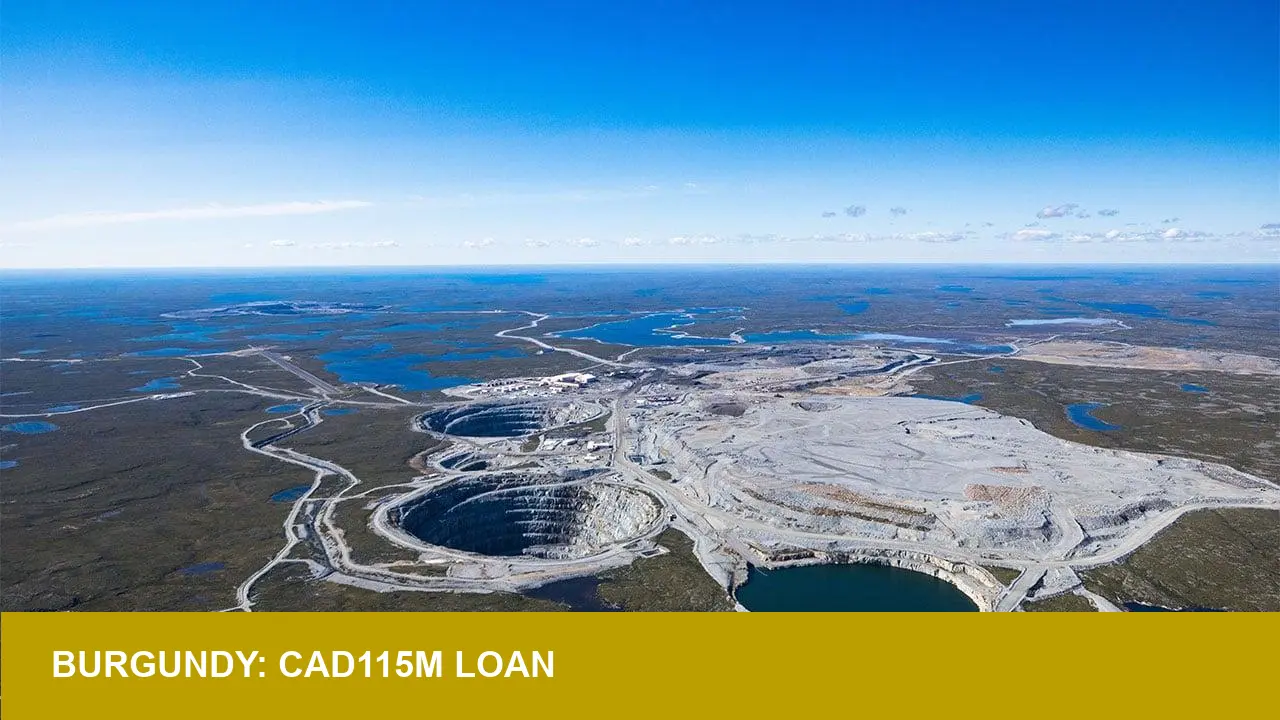
Burgundy Diamond Mines has secured a CAD115 million (US$83.3 million) loan from the Canada Development Investment Corporation to keep the Ekati mine operating through a prolonged rough‑diamond downturn. The facility underwrites underground development, reactivates open‑pit work and funds processing at Fox — a lifeline intended to preserve the company’s access to higher‑value deposits while it restructures.
- Price: CAD 115 million (up to), approx. US$83.3M
- Carat Weight: N/A — mine‑level financing, focus on higher‑value parcels
- Origin: Ekati, Northwest Territories, Canada
- Date: December 21, 2025
What the deal covers
The credit line, provided through CDEV’s facility for large Canadian enterprises affected by tariffs and countermeasures, gives Burgundy the working capital to continue underground development at Ekati, reactivate the Sable open pit and complete the Fox underground processing plant. In return, Burgundy will issue shares to the lender and accept a balance‑sheet restructuring. The company also plans to close its Antwerp sales office to capture immediate cost savings and lean on outsourced auction and tender services for market access.
Context: 2025 market dynamics
Rough‑diamond markets entered 2025 with an uneven surface: a 50% U.S. tariff on imports from India — where roughly 90% of global cutting and polishing occurs — has compressed margins and dislocated traditional trading routes. For mines like Ekati, that has translated into a protracted, low‑velocity market where inventory carries the tactile burden of opportunity cost.
At the same time, two 2025 trends are reshaping asset valuation. First, sustainability and traceability premiums are giving responsibly managed, origin‑certified stones added price resilience. Second, the continuing ascent of lab‑grown diamonds is reframing what retailers and consumers pay for natural rough: scarcity‑driven parcels and stones with distinct vitreous luster now command a wider spread. Burgundy’s stated pivot toward higher‑value deposits reflects both pressures.
Why this matters to U.S. retailers and investors
For U.S. retailers, Burgundy’s loan removes an immediate supply‑shock risk: continued Ekati production helps preserve a pipeline of natural, Canadian‑origin diamonds that carry traceability credentials increasingly prized by consumers. The Antwerp closure signals a shift toward third‑party sales platforms and auctions — a channel change that can compress lead times but may also concentrate parcel quality into fewer, higher‑value tenders.
For investors, the funding is a low‑probability, high‑impact event. The CDEV facility provides substantial heft to Burgundy’s near‑term liquidity, but it comes at the cost of equity dilution and an enforced restructuring. That trade‑off matters: if Burgundy can lower its all‑in costs and focus output on premium parcels, the company could preserve margin on a smaller production base — improving return profiles when market velocity returns. Conversely, continued tariff pressure or a deeper global demand slump would leave the lender holding a larger equity stake and shareholders facing further compression.
The practical takeaway
The CAD115M lifeline buys Burgundy time to execute a narrower, value‑focused strategy and to reduce operating cost per carat. For U.S. buyers seeking inventory with provenance and for investors tracking recovery plays in upstream producers, Ekati’s continuation is both a stabilizing influence and a reminder: in 2025, capital structures and market access often matter as much as the carat itself.
Image: Aerial view of the Ekati mine. (Burgundy Diamond Mines)
Image Referance: https://rapaport.com/news/ekati-owner-secures-funding-to-keep-mine-afloat/