
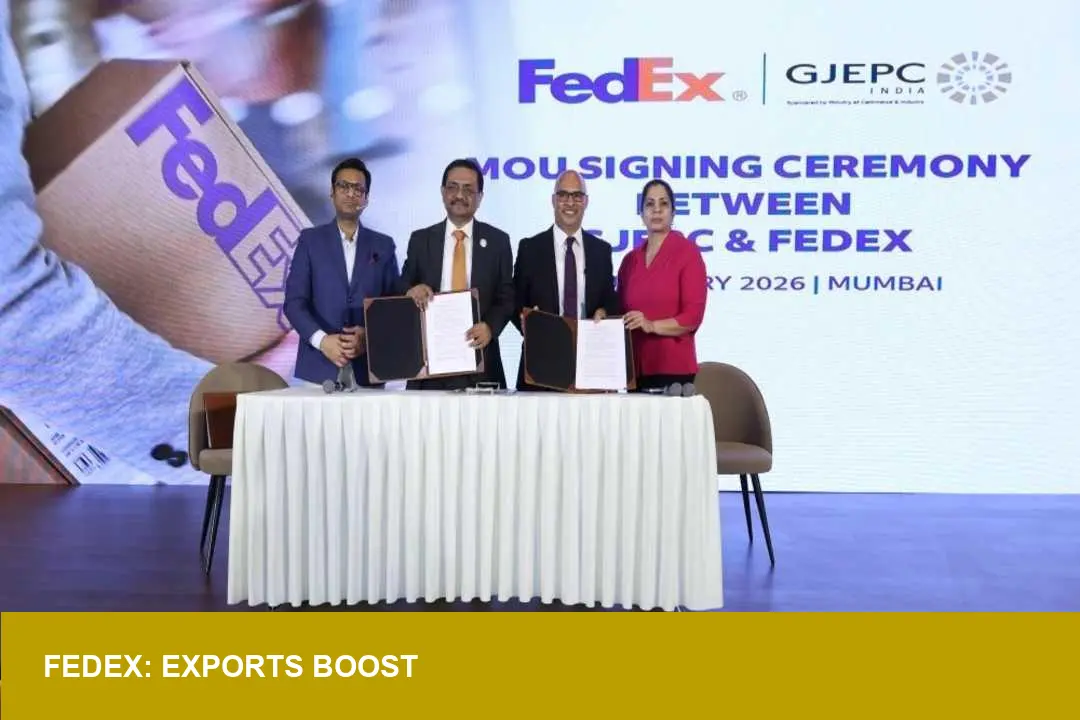
FedEx and the Gems and Jewellery Export Promotion Council (GJEPC) have signed a Memorandum of Understanding to shorten lead times and open reliably routed markets for India’s gems and jewellery sector — a move that targets exporters behind the 6.8% share of national merchandise exports and promises measurable gains to margins and inventory velocity.
- Parties: FedEx & GJEPC
- Scope: Time-definite international shipping, integrated customs clearance, exporter education
- Network: 36 weekly flights to/from Mumbai, Delhi, Bengaluru; markets covering >99% of global GDP
- Date announced: January 2026
What the pact delivers
The agreement pairs GJEPC’s industry mandate with FedEx’s air network and digital stack — including the AI SATS integrated hub in Bengaluru — to provide end-to-end visibility, predictable door-to-door movement and structured knowledge-sharing for exporters. For finished jewellery, where a piece’s vitreous luster and substantial heft can speak to value on arrival, the measured cadence of time-definite delivery reduces exposure to transit damage, opaque customs holds and delayed payments.
Context: how this fits 2025 market trends
Three dynamics make the alliance timely. First, cross-border e-commerce and direct-to-buyer channels are compressing supply chains; retailers expect replenishment with near-precision. Second, sustainability is moving from marketing line-item to operating mandate: faster, fewer-miles routing and consolidated freighter loads can lower per-piece carbon intensity and compliance risk for brands selling into ESG-aware Western markets. Third, the continued expansion of lab-grown diamonds and sculptural, design-forward jewellery has shifted price mixes and inventory profiles — smaller carat weights, higher design premiums — increasing the value of reliable, trackable logistics that preserve finish and provenance.
Impact for US retailers and investors
For a US buyer or investor, the practical effects are immediate. Shorter, more transparent transit shrinks safety-stock requirements and reduces working capital tied up in transit. Predictable customs processing lessens forced discounts on late deliveries; improved visibility mitigates reputational risk from damaged pieces. For private-equity and wholesale buyers, improved logistics tilt sourcing economics: faster turns and lower logistics leakage increase gross margins on Indian-sourced product, particularly for MSME partners that previously lacked structured export channels.
Operationally, expect three measurable outcomes over 12–18 months: reduced lead times for finished goods and components, higher fill rates for seasonal drops, and improved traceability that supports both due-diligence and ESG claims. The partnership’s seminars and exporter sessions also accelerate exporter sophistication — paperwork, HS codes, insurance practices — which translates into fewer denied shipments and lower claims ratios.
Market takeaway
Quietly, this is infrastructure investment rather than headline stimulus. For the Indian industry it is a logistics backbone; for US players it is a lower-friction channel to scale sourcing from India with more predictable economics. Brands that prize finish and provenance should regard the pact as a de-risking event: reduced transit uncertainty helps preserve a piece’s visual integrity — the vitreous luster, the locked-in clasp’s substantial heft — while protecting margins.
Nitin Navneet Tatiwala, Vice President — Marketing, Customer Experience and Air Network, Middle East, Indian Subcontinent and Africa at FedEx, framed the pact as a long-term supply-chain commitment to Indian exporters. GJEPC Chairman Kirit Bhansali described the agreement as a logistics enabler for MSMEs and cross-border e-commerce sellers seeking dependable door-to-door solutions.
Image Referance: https://themachinemaker.com/news/fedex-and-gjepc-partner-to-boost-indias-gems-and-jewellery-exports/