
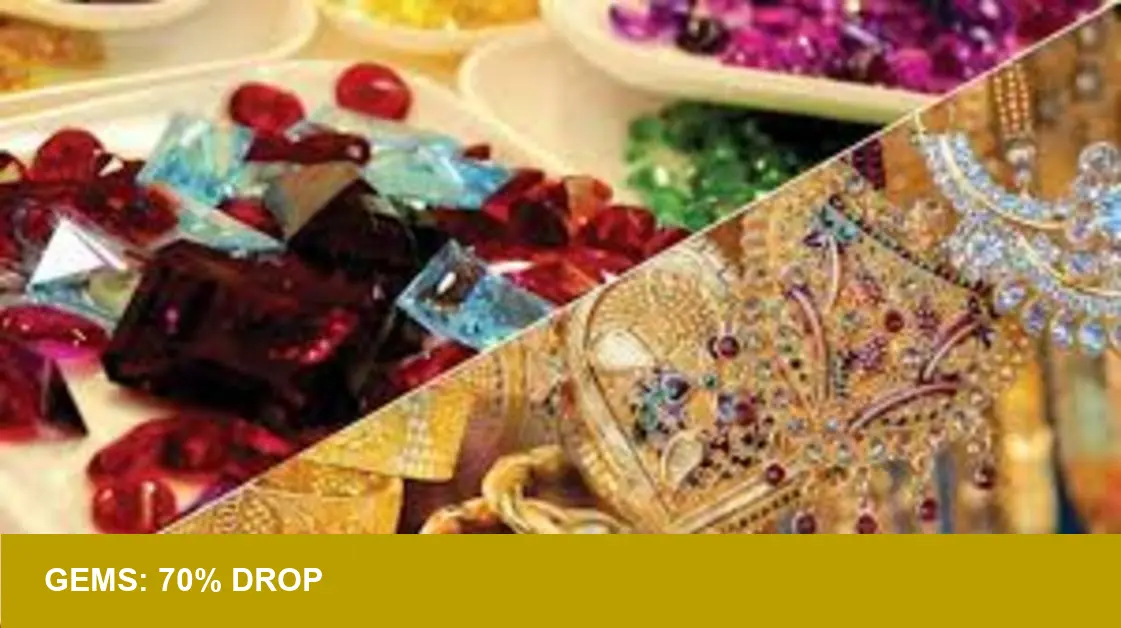
Lede: India’s gems and jewellery exports to the United States have fallen sharply — roughly 69.7% since September after a 50% reciprocal tariff — shrinking the sector’s contribution to merchandise exports from around 15% in FY13 to 7% in FY25 and forcing immediate margin and sourcing reassessments.
- Price: Export value contraction — c. -69.7% since September (post-tariff).
- Carat Weight: Not reported for trade aggregates; metric is value-driven rather than gem-specific.
- Origin: India (US-bound shipments); data sourced from CareEdge.
- Date: Data through FY25; April–August decline -33.9%, post-September decline -69.7%.

Context: Tariffs, Front‑loading and 2025 Market Shifts
The immediate cause is policy: a 50% US reciprocal tariff on selected Indian goods triggered a two‑phase reaction. Some categories recorded temporary growth as exporters front‑loaded shipments ahead of the tariff window; gems and jewellery did not sustain that buffer. CareEdge’s analysis shows the category’s share of shipments to the US at 11.5% (down from 18.5% in 2012), and its share of India’s total merchandise exports at 7% in FY25 versus about 15% in FY12–FY13.
Beyond headline numbers, this episode intersects with three 2025 trends. Sustainability and traceability are now table stakes: buyers prize provenance and low‑carbon production, which can favour vertically integrated or lab‑grown supply chains. The lab‑grown diamond segment continues to advance both price transparency and shorter supply chains, reducing some tariff exposure through domestic or regional processing. Finally, consumer tastes are tilting toward sculptural, substantial pieces — items with visible “substantial heft” and a pronounced presence — which changes SKU mix and average unit values.
Impact: What Retailers and Investors Should Do Now
For US retailers the fallout is immediate and practical. A 50% tariff is not an aesthetic issue; it is a margin problem. Imported inventory carries a new cost floor, compressing retail margins unless prices are adjusted or sourcing changes. Actions to consider:
- Reprice discreetly. Preserve category positioning by recalibrating markup on lower‑turn SKUs while protecting margin on statement pieces that display visible “vitreous luster” and command price resilience.
- Diversify sourcing. Accelerate relationships with non‑tariff suppliers, regional processors, or lab‑grown producers to shorten logistics and reduce tariff incidence.
- Inventory triage. Prioritise pieces with higher perceived value per unit weight — finished jewellery with craftsmanship or proven provenance — over raw commodity units that absorb tariffs most acutely.
- Hedging and financing. Use vendor credit, consignment, and forward purchasing to smooth cash flow while reassessing inventory turns to avoid markdown cycles.
For investors, the lesson is risk re‑pricing. The tariff episode reveals concentration risk in trade corridors and the sensitivity of discretionary categories to trade policy. Distressed inventory and supply‑chain reconfiguration can create selective buying opportunities — particularly in brands or ateliers with strong provenance, in‑house finishing, or flexible production that preserves “substantial heft” without eroding margin.
CareEdge’s figures make the point starkly: gems and jewellery have been the hardest hit among US‑bound Indian export categories. For US market participants the immediate task is structural — adapt sourcing and assortment to a higher cost environment while using provenance and design to justify retained price points.
Source: Deccan Chronicle (CareEdge analysis)
Image Referance: https://www.deccanchronicle.com/business/gems-and-jewellery-hardest-hit-by-tariffs-with-drop-of-70-pc-1923722