
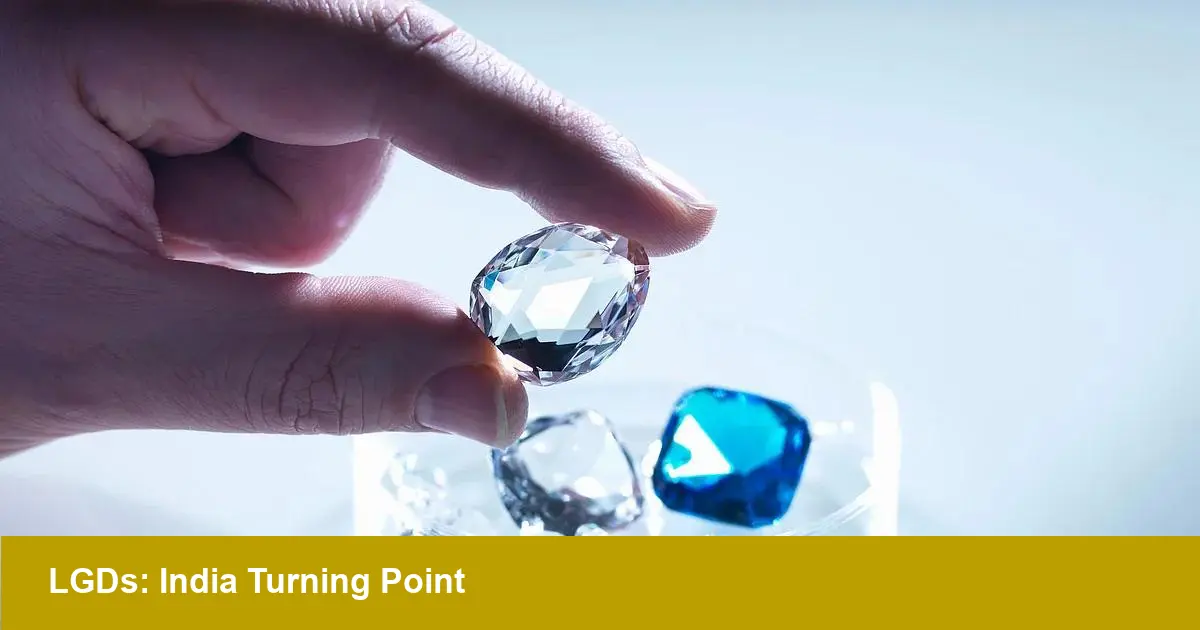
Lab-grown diamonds are expanding India’s jewellery market and changing how value is assigned — not by supplanting gold or natural stones, but by creating a lower-price ladder that could raise household diamond penetration to 10–15%.
- Price: Typically priced at less than 50% of comparable natural diamonds
- Carat focus: Visible sizes (commonly 0.25–1.0 ct) that prioritise apparent carat over certificate-driven premiums
- Origin / Production: CVD and HPHT processes; growing manufacturing and polishing capacity in India
- Date: December 12, 2025
What changed
India’s jewellery marketplace has long been anchored by gold’s ritual heft and natural diamonds’ certified scarcity. Lab-grown diamonds (LGDs), chemically and optically comparable to mined stones but engineered through CVD and HPHT, introduce a third commercial axis: design-led, access-driven diamond jewellery at materially lower price points. The immediate financial implication is not substitution but expansion — new buyers, new occasions, and new margin structures for retailers.
How the categories settle
Gold retains its ceremonial and store-of-value role, with purchases tied to weddings, festivals, and familial transfer. Natural diamonds remain the currency of permanence — engagement rings, heirlooms and high-involvement family purchases reinforced by global branding and certification. LGDs occupy an adjacent territory: spontaneous, self-led purchases that prioritise vitreous luster and visible carat over investment thesis. For chains such as Kalyan Jewellers, Malabar Gold & Diamonds and Joyalukkas, LGDs sit alongside core assortments rather than replacing them.
Market mechanics and scale
LGDs are priced at under half the cost of natural stones — a structural gap that converts aspirational desire into attainable transactions. India’s diamond penetration has historically hovered at 4–7% of households; LGDs could expand that band to 10–15%, driven by younger professionals, self-purchasing women, fashion-led buyers and Tier II–III aspirations. Retail experiments from Trent’s POME line to digital-first labels such as Limelight and Jewelbox show how lower entry prices and aggressive online outreach accelerate velocity.
Context: 2025 trends shaping the category
Three 2025 trends converge to sustain LGD momentum. First, sustainability narratives — reduced ecological footprint and traceable production — resonate with urban, values-driven buyers. Second, the lab-grown value proposition is increasingly about design and sculptural aesthetics rather than discounting alone: contemporary silhouettes, modular settings and mixed-metal treatments. Third, supply-side scale in India — from growing CVD capacity to established polishing clusters — offers margin arbitrage for brands that vertically integrate or white-label production.
Why this matters to U.S. retailers and investors
For U.S. retailers and investors, India’s trajectory presents three distinct plays:
- Sourcing and margin capture: India’s expanding LGD manufacturing and polishing base can lower landed cost for American brands willing to partner on production or private-label runs.
- Market-design testing: The Indian consumer’s appetite for visible carat and design-led pieces creates a testing ground for high-velocity SKUs that can be adapted for U.S. younger cohorts seeking contemporary, affordable diamond jewellery.
- Portfolio diversification: Carving separate brand architectures for mined and grown diamonds preserves premium equity while unlocking a faster-turning, lower-price category that broadens addressable demand.
Operationally, success requires clear role definitions: avoid mixing milestone jewellery with everyday luxury in a single consumer promise; instead, deploy distinct narratives, price ladders and retail touchpoints. Brands that confuse the two risk diluting symbolic equity; those that segment will unlock incremental customers without eroding premium margins.
Bottom line
Lab-grown diamonds are not rewriting India’s jewellery story so much as widening its reach. They deliver a tactile, vitreous luster at substantially lower price points and create a new, self-led diamond consumer. For retailers and investors in the U.S., India’s ability to participate across mined, grown and branded supply chains makes it an important strategic market — one defined by clarity of role, not category conquest.
Note: Views reflect analysis by Neelesh Hundekari and Ankur Singh, Partners at Kearney.
Image Referance: https://www.fortuneindia.com/opinion/as-lab-grown-diamonds-redraw-category-boundaries-indias-jewellery-market-reaches-a-turning-point/128745