
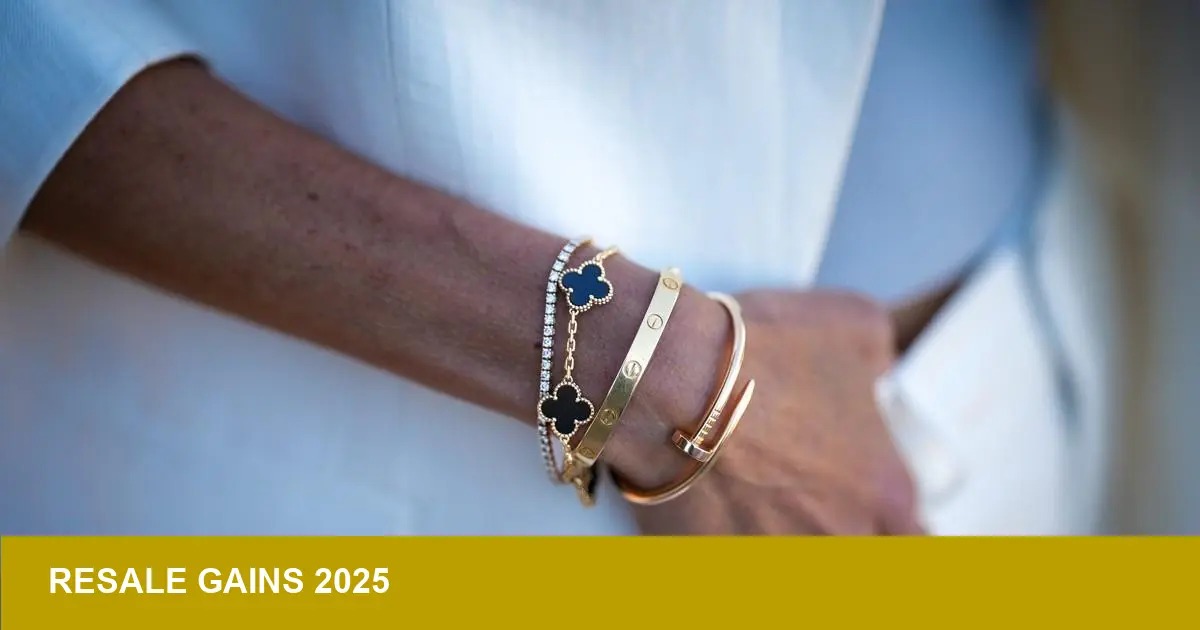
Rebag’s 2025 resale data names Van Cleef & Arpels, Rolex and Cartier as the leading value-holders — pieces that are not only retaining worth but, in cases such as the Sweet Alhambra bracelet and the discontinued Submariner “Hulk,” trading at clear premiums on the secondary market.
- Price: Van Cleef Sweet Alhambra bracelet — Retail $1,540; Rebag listing $2,020 (2025)
- Carat weight: Not applicable (bracelet with mother-of-pearl motif); Rolex Hulk — N/A (steel sports watch)
- Origin: Van Cleef & Arpels (France); Rolex & Cartier (Swiss-made watches)
- Date: Rebag annual resale report, 2025; market context through November 2025
Market snapshot
The headline: select high-end jewelry and watches are acting as asymmetrical assets in 2025. Van Cleef & Arpels led jewelry value retention at 112% on average, while specific models — notably the Sweet Alhambra bracelet — fetched 117% of retail on resale. Rolex, still in the “unicorn” tier, held 104% value overall, and a discontinued Oyster Perpetual Submariner “Hulk” averaged a 244% resale retention on Rebag. Cartier’s Santos and Love offerings rounded out the top performers with mid-to-high retention, buoyed by Gen Z demand.
Why the numbers matter in 2025
Several structural forces have converged. Tariffs raised primary-market pricing, prompting buyers to seek established pieces with demonstrable resale histories. At the same time, a growing cohort treats jewelry and watches as portable stores of value; tactile attributes — the vitreous luster of mother-of-pearl, the satin-brushed case and substantial heft of steel sports watches — help convey provenance and desirability on the secondary market.
Van Cleef & Arpels
Van Cleef & Arpels led the jewelry segment in 2025, with an average retention of 112%, up 9 points year-over-year. The Sweet Alhambra line — 18-karat gold and mother-of-pearl motifs with a refined vitreous luster — drove much of the lift. A single‑motif Sweet Alhambra bracelet, retailing at $1,540 before tax, is commonly trading around $2,020 on Rebag, an effective premium that signals collector appetite for specific, well‑handed references rather than broad category exposure.
Rolex
Rolex remained the category’s anchor. The brand’s overall 104% value retention confirms its continued pricing power. The discontinued Submariner “Hulk” (green bezel and dial), in particular, performed exceptionally: Rebag recorded an average resale retention of 244%, with a typical “good” condition example selling for roughly $19,415. The model’s discontinued status, combined with the substantial heft and recognizable design language, concentrates demand among both collectors and new entrants seeking low-volatility pieces.
Cartier
Cartier traces its gain to both watches and bracelets. The Love and Santos families saw notable turnover: Cartier’s average retention reached 87% in 2025, with the Santos touching 92% in “excellent” condition. A Santos example listed at $8,840 on Rebag compares closely with a retail tag of about $8,650, underscoring situations where resale can match or slightly exceed primary channels for certain references.
Context: sustainability, tariffs and consumer behavior
Beyond individual brands, three 2025 trends shape the picture. First, tariffs and higher retail pricing nudged tentative buyers toward pre‑owned inventory. Second, sustainability narratives — lower carbon footprints for circulated goods — increasingly influence purchase rationales, especially among younger buyers. Third, the rise of lab‑grown diamonds and accessible design alternatives has re‑segmented demand: consumers looking for store-of-value items continue to prefer historically scarce references and precious metal constructions over mass-produced, lab-grown options.
Impact for US retailers and investors
For retailers: cultivating authenticated, well-photographed inventory of the exact references that show historical premiums will increase turnover and margin. Emphasize condition reports, full-service polishing (conservative, preserving original finishes) and provenance notes — these tactile details translate into higher bids. For investors: the data reiterates a concentrated strategy. Outperformance is not broadly distributed across brands or models; it clusters in identifiable references with limited supply or discontinued runs. Consider allocation limits, insurance costs and liquidity timelines — resale premiums may be meaningful, but realizing them requires active market placement.
As Rebag’s CEO Charles Gorra noted, higher prices in the primary market have reaffirmed the secondary channel’s role as a reliable avenue for collectors and buyers seeking value. For anyone operating in the US jewelry and watch market in 2025, the takeaway is precise: inventory selection and condition integrity now carry direct financial consequences.
Image Referance: https://africa.businessinsider.com/retail/the-watch-and-jewelry-brands-dominating-the-2025-resale-market-and-holding-their/c8zwf5y